

In this article
Your dog has settled near the window, the phone is ready, and the preview contains a splendid view of the sofa with a small dog somewhere behind it. Before recording, look at the picture you are about to send.
A useful clip starts with a few practical choices. Here is how to prepare the frame, choose a length and understand the difference between an unclear answer and a capture that is still waiting.
Start with the dog you mean
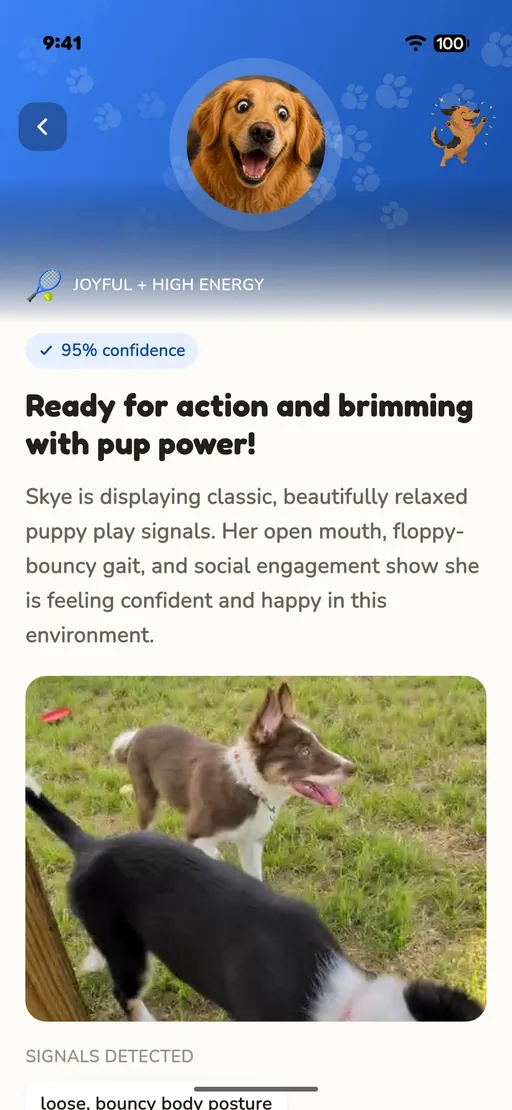
Before tapping the paw, check which dog is selected on Home. That is the dog the app will read3.
The how-it-works guide says a small profile photo can help identify the selected dog in a personalised read. That reference is conditional: with Personalised insights off, the AI receives the clip without profile information or context tags3.
Now consider what a stranger could identify in the picture. If two dogs are crossing in front of each other, you may know which is which because you watched them enter the room. The recording needs to contain useful evidence of its own. A mental label you have given a dog does not appear in the frame.
Put the light where the dog is
Let light fall onto the face and body, avoiding a bright window behind. Move closer if the dog appears very small in the preview1.
The preview shows the full frame that is sent. Dogoos identifies darkness, blur, partial views and difficulty distinguishing dogs in a crowded frame as reasons it may be unable to read clearly3. A beautiful background is little help if the subject has almost disappeared.
Imagine the same room from two positions. From one, the bright window is behind your dog and the face looks like a silhouette. From another, you can make out the face against the room. Compare what you can see in the preview; the attractive view through the glass is not the purpose of this photograph.
Look at the picture before the moment
- Which dog is identifiable?
- What part of the body is missing?
- Can I distinguish the face from the background?
- Does furniture interrupt the view?
- What would I change before choosing to record?
Leave room for ears, posture and movement
Dogs Trust advises looking from head to tail, because different parts of the body can give mixed information. The situation matters too: a behaviour around dinner preparation can mean something different in another setting2.
A scientific review describes visual communication through posture, facial movement, ears and tail, alongside acoustic and other channels. It notes that long or dense coats can conceal movements, and that anatomy can limit the signals available through faces, ears or tails4.
That makes a generous view useful without suggesting every dog should resemble a diagram. Learn what the individual normally looks like. A naturally curled tail does not become an emotional measurement merely because its shape is easy to recognise2.
One video study included 2,163 human participants with different levels of dog experience. Greater experience was associated with better agreement with an expert panel about fearful examples. Experienced participants also reported using more physical features, with a particularly marked difference for ears5.
Those were participants' reports about informative features, not eye-tracking measurements. The study used a self-selected sample and expert categorisation without physiological confirmation of the dogs' feelings. It did not test Dogoos or establish a filming technique that increases an app's accuracy5.
The sensible application is to preserve possibilities for observation. A tight portrait may be a lovely keepsake while leaving you unable to review what the legs, weight or tail were doing at that moment. Decide what you want to understand before filling the screen with a nose.
Let ordinary behaviour continue
Dogs Trust explains that signs of discomfort can be subtle and recommends stopping an interaction and creating space when a dog is worried. New or changed body language warrants a vet check for possible medical causes2. Getting a clip is secondary to responding to the dog.
You do not need to recreate a troublesome encounter to document your question. Write down what preceded it, what you saw and what happened afterwards. That preserves a useful account even if no recording exists. An incomplete record is preferable to repeating an upsetting event for a better view.
The communication review describes how sounds can carry information as well as visible movements, while emphasising that individual behaviours need to be considered alongside other signals4. This does not turn a particular bark or pose into a reliable emotional translation.
Choose a length for the question
Every plan offers five seconds. Paid plans or an active Tracker Pass also offer ten or twenty seconds. Microphone access is optional; visible clues still inform a video-only read1.
The plans guide confirms that paid access adds longer clips and that a Tracker Pass is temporary access with an end date6. Check the access shown on your account before assuming that another household member's plan determines your choices.
| Your question | Consider before recording |
|---|---|
| A brief moment | What single observation am I trying to preserve? |
| A change during an activity | Will the recording include the part I want to compare? |
| An unclear view | What can I improve in the picture first? |
Longer need not mean more informative. An extra stretch of an obstructed view still leaves the obstruction in place. Equally, a short observation cannot include what happened before recording began. Choose a question small enough for the moment you can actually see, and keep any wider history beside it.
Understand an unclear result
An unclear answer means usable evidence was insufficient. Improve light or framing before another capture. Confidence is no guarantee of how the dog feels1.
The how-it-works page says an unclear card gives a reason and labels any best guess accordingly3. Read that explanation before deciding what to do next. A result that acknowledges limited evidence should not become an instruction to keep recording until a preferred label appears.
For a black preview, the troubleshooting guide recommends closing other camera apps, checking camera permission and reopening the read screen, then restarting Dogoos if needed. For a waiting capture, open its item in Home's read queue and follow its status7.
Those are different problems. One concerns a camera that has not produced a usable preview; another concerns a capture already in progress. Knowing which message you have prevents an unnecessary sequence of new recordings.
Know when a read is used
Filming and waiting for a connection do not spend a read. Resuming the same capture does not spend twice. Waiting does not reserve allowance, and cancelling after acceptance does not return it1.
After a message appears
- Identify the stageIs this the preview, a waiting capture or a finished result?
- Read the explanationWhat does the screen say happened?
- Choose the next actionFollow that message before making another capture
The troubleshooting guide asks for the exact message, device and action when a problem persists. Leave passwords, payment details and private clips out of a support enquiry7. A precise description is more useful than a guess about which part went wrong.
For your next ordinary moment, spend a little attention on the preview first. Keep the question clear, give the dog room to carry on, and let the recording contain what you actually wanted to observe.
Sources and further reading7 sources
The small numbers in the article link to the source behind each fact. Sources open on their own websites.