

In this article
- Diagnosis has a specific meaning
- Training help and clinical behaviour support are different jobs
- Find a person, then check what they offer
- Ask Rex to keep the observation straight
- Keep medication wording with the person who prescribed it
- A note is useful because it stays an observation
- Finish the conversation with a clear next step
Rex can help keep your dog's care records and everyday information together. Dogoos draws a clear line at diagnosis and calculating medication doses: a health question belongs with your vet1.
That still leaves useful work for a conversation. You can organise what you noticed, prepare a question or find a person to help. The important distinction is between making that next step easier and treating a reply as a clinical decision about your dog.
Diagnosis has a specific meaning

Section 27 of the Veterinary Surgeons Act includes diagnosing animal disease or injury, advice based on that diagnosis, and medical or surgical treatment within veterinary surgery3.
Section 19 generally restricts practising veterinary surgery to people on the veterinary or supplementary register, subject to the Act's exceptions4. Those qualifications matter: the law is not a blanket statement that no owner can give permitted care.
For this feature, the practical boundary is the one Dogoos publishes: Rex does not diagnose or choose a dose1. Do not turn a conversational explanation into a decision to start, stop or change treatment.
Imagine asking two different questions. One is how to record the change you have noticed. The other is whether it establishes a particular condition. Writing an account can help you bring the second question to the right person; it cannot answer it merely by becoming more neatly phrased.
Training help and clinical behaviour support are different jobs
The Animal Behaviour and Training Council distinguishes trainers and training instructors from clinical animal behaviourists. Its role descriptions put clinical behaviour work on veterinary referral, while a veterinary behaviourist is also a veterinary surgeon5.
That distinction is useful when deciding what kind of support to seek. A request for help teaching a familiar skill is different from asking why a dog has suddenly become frightened or defensive. Be clear about the problem you actually want help with instead of deciding the answer must be a training exercise.
Dogs Trust recommends a vet check for changes in normal behaviour, new responses or changes in eating, drinking, sleeping and toileting. Pain and other medical problems can affect behaviour6. Start there when a change worries you.
If the dog looks uncomfortable during an interaction, Dogs Trust advises stopping and helping them gain space6. You do not need to wait until you have named the emotion or worked out an explanation before making the immediate situation easier.
Find a person, then check what they offer
Dogoos's trainer page lets you explore nearby trainers and behaviourists using a location or postcode. It distinguishes directory labels and explains that Bookable places support booking through Dogoos; other listings provide contact routes7.
Treat a listing as the start of your enquiry. Ask what kind of work the practitioner does, how their qualifications can be checked, which methods they use and how they work with your vet. Explain any safety concerns before arriving at a class or arranging a meeting.
The ABTC's directory links sit beside its role descriptions, and registered practitioners must maintain continuing professional development5. Choose the relevant role rather than assuming every professional title describes the same service.
The Dogoos page also presents Rex as a way to discuss ideas between training sessions7. Keep the plan agreed with the professional beside those ideas. If something does not fit your dog's circumstances, ask the person who assessed the situation rather than combining several suggestions into a new programme on your own.
Ask Rex to keep the observation straight
The Rex walkthrough recommends giving names, dates, times and other useful details. It explains how to check a proposed action, correct it and open the related activity bubble to verify the saved record8. A typed request alone is not proof that it saved.
Try organising a note in three parts: what you directly observed, when it happened and what you remain unsure about. For example, you may know that a change occurred after a walk while not knowing whether the walk had anything to do with it. Keep both the observation and the uncertainty.
Details to gather for a useful conversation
- Which dog am I describing?
- When did I first notice this?
- What did I actually see or hear?
- What happened just before and afterwards?
- What instructions has the vet already given?
- Which question do I need answered next?
Do not polish away the limits of your memory. If you were not there, say who saw the event. If the timing is approximate, keep that clear. You are preparing a record that someone else may need to interpret, rather than trying to make your account sound certain.
Keep medication wording with the person who prescribed it
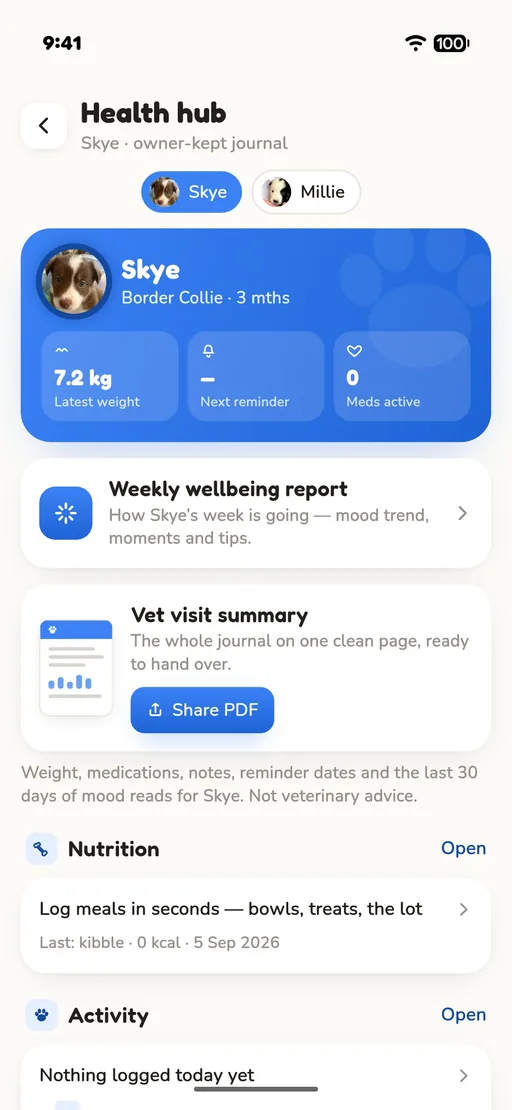
Dogoos says Rex keeps a supplied dose as free text rather than converting or calculating it1. The support guide says medication instructions and changes belong with your vet, and asks you to check the details before saving a dose or reminder8.
Recording an instruction and checking that it is medically suitable are different tasks. If you cannot read a label, are unsure which instruction applies or think the plan has changed, contact the practice. Do not ask a chat reply to fill the gap with a plausible number.
Before confirming a record, compare it with the actual instruction you have been given. Check the dog as well as the wording. In a home with more than one animal, a familiar medicine name is not enough to tell you that the entry belongs to the right patient.
The walkthrough's default confirmation setting lets supported journal actions wait for approval. If something is wrong, tell Rex what to change and check the related care screen afterwards8. A successful save means the record was stored, not that a vet has reviewed it.
A note is useful because it stays an observation
Dogs Trust notes that diaries, observations and recordings can help a veterinary appointment6. You can bring a concise account without first converting it into a diagnosis.
For example, compare describing a new response with declaring what condition caused it. The first leaves room for questions about the dog's health and circumstances. The second may hide the very uncertainty the appointment needs to explore. Use ordinary words when ordinary words say what happened most accurately.
If the concern is urgent, return to the emergency route. PDSA recommends keeping the out-of-hours number available and checking your practice's arrangements in advance2. An account allowance, a device problem or a missing entry should not decide when an animal gets help.
Finish the conversation with a clear next step
Where the question goes next
- Everyday skillDiscuss an appropriate training goal
- New worrying changeArrange veterinary assessment
- Existing instructionConfirm unclear wording with the practice
- Care recordCheck what was actually saved
Rex can make the record and the next question easier to find. Keep the final choice attached to the right kind of help: a practitioner for the work they are qualified to do, and your vet for diagnosis and treatment. The useful outcome is knowing what to do next for this dog, rather than getting the most confident-sounding answer.
Sources and further reading8 sources
The small numbers in the article link to the source behind each fact. Sources open on their own websites.
- Ask Rex: log a meal and a walk in one sentence
- Getting emergency vet care for your pet
- Veterinary Surgeons Act 1966, section 27
- Veterinary Surgeons Act 1966, section 19
- Types of Practitioners
- How to understand your dog's body language
- Fetch: Trainers and behaviourists
- Chat, log care and find places with Rex