

In this article
You film your dog by the back door for five seconds, and the read comes back: Uncertain, 64% sure. What should you make of that? Knowing what sits behind the number helps you decide how much weight to give it.
A read offers a best guess about how your dog seems in one short clip, with cues you can check for yourself. It cannot see inside your dog's head. Here is what it looks at, what its confidence means, why it sometimes refuses, and where its limits lie.
What a read looks at
Tap the paw, film your dog, and Dogoos reads the face, body posture and vocal tone together1. It comes back with one of six moods: Playful, Engaged, Uncertain, Puzzled, Startled or Appeasing1. Reads are taken in the phone app; the web app at app.dogoos.com shows your mood history but can't take one1.
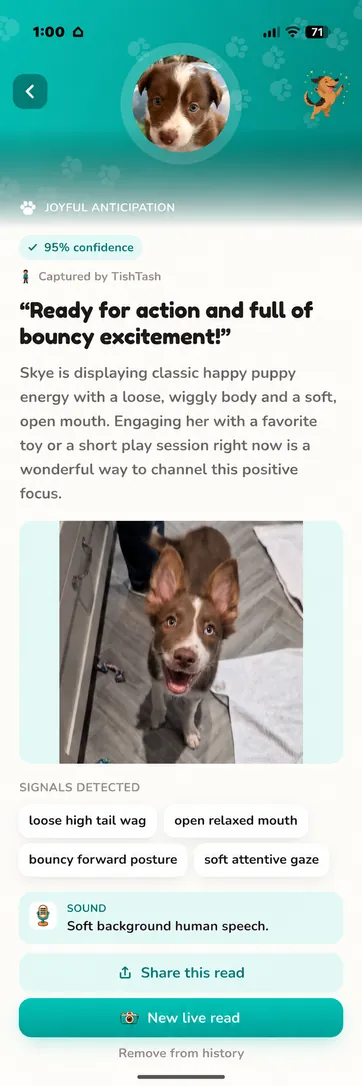
Under the mood come the parts worth reading slowly: a confidence figure, a score for how much the face, the body and the sound each carried the answer, and three or four named cues, such as “averted gaze” or “ears pinned forward”1. The big headline is a playful line that interprets the body language, and never a claim that your dog said words1. If you'd rather not allow the microphone, a video-only read still uses what it can see2.
Those cues matter because dogs don't do faces the way we do. Researchers at the University of Lincoln coded the facial movements of 100 family dogs and 50 people in online videos of emotional moments, from thunderstorms to reunions. The dogs made distinctive movements in some situations, but different movements from the people, and the team concluded that dogs do not display human-like facial expressions4.
Most of the dogs' emotional facial movements were around the mouth, using the tongue or opening the mouth, and none were around the eyes, where people make many of theirs4. For frustration, the dogs showed no distinctive facial movement4. The authors warned that broad descriptions, and labelling a whole face in one go, can bias how people read another species4. A list of small, concrete cues gives you something to check against your own dog.
Myth: a high percentage means the read is right
The confidence figure is one the AI set for itself, shown just as it came back1. Dogoos describes it as how clear the interpretation was, and says it is not a guarantee about how your dog feels2. So 95% sure means the AI was very sure of its reading of that one clip. It is the AI's own judgement, not a hit rate worked out by marking reads against expert judges.
Low numbers count too. You always see the figure, however low, and Dogoos treats it as a real answer1. A read at 45% is saying the AI found it a harder call, so check the cues against your dog before you lean on the label.
Myth: every clip gets a clear verdict
When your dog is hard to see, too dark, too blurry, half out of frame or behind the sofa, you get a different card. It says “Couldn't read clearly”, gives the reason in plain words and shows a best guess, clearly labelled as one1. It means there wasn't enough usable evidence2.
A crowded frame gets the same treatment. Asked to read one dog and handed three, with no way to tell which is yours, a read says so instead of blending them into one verdict1. With Personalised insights on, your dog's profile photo travels with the clip to help it pick the right one1.
The card offers Try again and Close, and a lamp switched on or a step closer is usually all it takes1. One thing to know before you film in the gloom: once the upload has been accepted, an unclear result still uses one of the day's reads2.
Myth: a read can tell you what your dog really feels

No app can, and nor can a scientist. Researchers who study animal emotion point out that the conscious experience of an emotion cannot be assessed directly. What can be measured is behaviour, body changes and brain activity5. Even a face is only part of the picture, one sign used to infer emotion alongside others4.
A read works from the outside in, from a few seconds of what a camera can see and hear, so it is an estimate of how your dog seems in that moment. It will never tell you your dog feels guilty: Dogoos calls that head-low, ears-back posture Appeasing, a response to your tone and body language1. None of the six moods is pain or illness, and a read is never a diagnosis1.
| A read can tell you | A read can't tell you |
|---|---|
| How your dog seems in this clip | What your dog feels inside |
| Which cues the answer rests on | Whether your dog is in pain or unwell |
| How sure the AI was of its reading | Whether one moment is a pattern |
Myth: you can always tell by looking
Most of us are better at spotting a happy dog than a fearful one. In an online study of 2,163 adults, mostly in the United States, people watched short videos that a panel of dog behaviour professionals had labelled happy or fearful6. Happiness was easy for nearly everyone. Fear depended on experience6.
What 2,163 people saw
The more experienced people also used more of the dog to decide, and paid particular attention to the ears6. The study measured agreement with the expert panel, not what the dogs truly felt, but the gap is a useful warning: fear is the easy thing to miss.
What's going on around a dog sways us too. In a 2025 study, students rated videos of a single dog, some edited so the dog appeared in a different situation. Clips in which the person was doing something positive got more positive ratings of the dog's mood, whatever situation the dog had really been filmed in7. One dog and a student sample make it a narrow test, but the authors concluded that things besides the dog itself have a big say in how we judge its emotions7.
A read's named cues pull your attention back to the dog. If the card says “averted gaze” or “ears pinned forward”, look for them yourself before you settle on what the moment meant.
Getting the most from a read
A single read is one snapshot. Reads earn their keep over time: Mood history, under Settings and Your pack, shows them by dog and date range, and Dogoos's own advice is to compare patterns over several days instead of treating one read as a diagnosis3.
Using a read well
Do
When to talk to your vet or a behaviourist
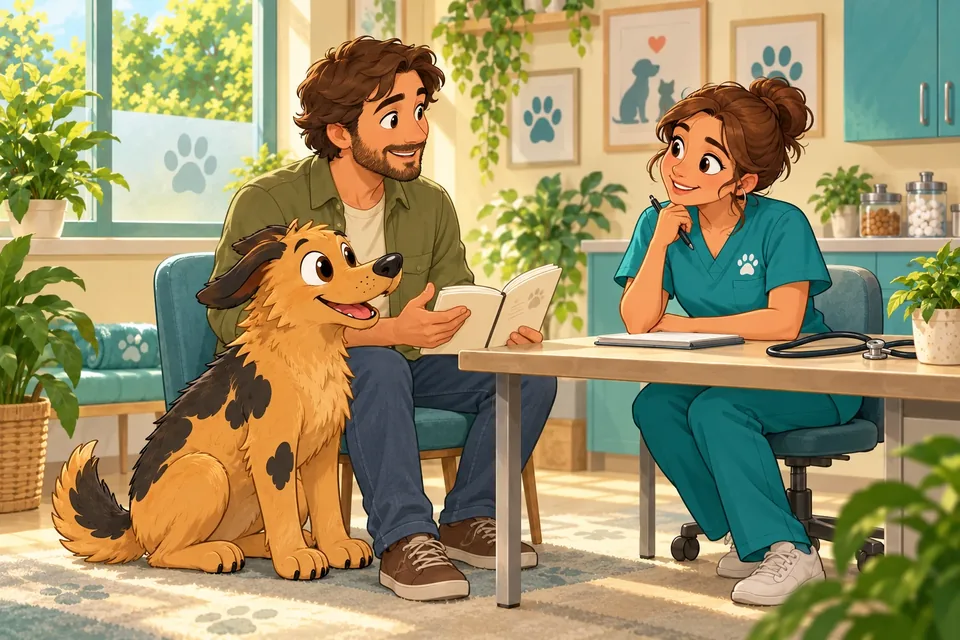
Dogoos offers guidance about a moment, and changes that worry you deserve a conversation with your vet2. Pay attention to a dog who suddenly seems uneasy, snappy or withdrawn, or a mood that keeps turning up where it never used to.
Pain can sit behind a change in behaviour. In a 2020 commentary, behaviour clinicians reviewed recent dog cases from their own referral clinics in the UK, the US and Spain. Their conservative estimate was that around a third of referred cases involved some form of painful condition, and at some clinics it was around 80%8. So book a vet check first8. If your vet finds no medical cause and the behaviour still worries you, ask them about a qualified behaviourist.
Let a read draw your attention to the dog in front of you: the ears, the mouth, the way they hold their weight. Check the cues against what you can see, then keep watching after the clip ends.
Sources and further reading8 sources
The small numbers in the article link to the source behind each fact. Sources open on their own websites.
- How a Dogoos read works: five seconds, three signals
- Reads and the camera
- Keepsakes, History and Stories
- Dogs and humans respond to emotionally competent stimuli by producing different facial actions
- An integrative and functional framework for the study of animal emotion and mood
- Human Perception of Fear in Dogs Varies According to Experience with Dogs
- Barking Up the Wrong Tree: Human Perception of Dog Emotions Is Influenced by Extraneous Factors
- Pain and Problem Behavior in Cats and Dogs