

In this article
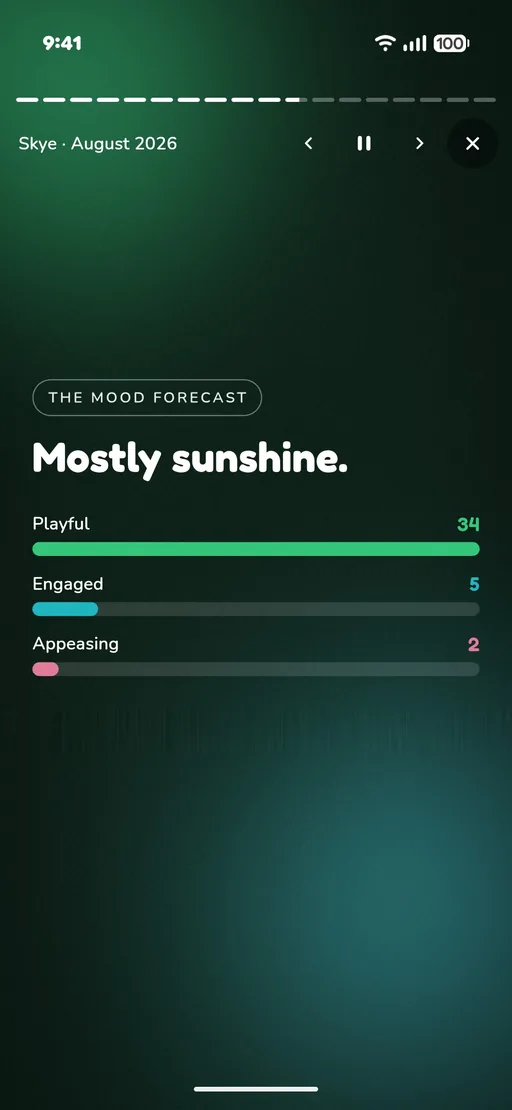
Story Mode can call a month The Sunrise Smiler or The Old Soul1. You can enjoy the name and still leave room for everything else you know about your dog.
The memories walkthrough describes the card as a reflection of that month's saved reads, rather than a clinical assessment or prediction2. Start with that distinction, then look at the moments behind the name.
Four axes make the name
The full set combines four axes. Dogoos uses these ingredients1:
| Axis | Basis in the reads |
|---|---|
| Sunny or Deep | Confidence-weighted share of Playful and Engaged |
| Steady or Wildcard | Whether one mood exceeds half the month |
| Face-first or whole-body | Which signal was read more strongly |
| Sunrise or Moonlight | Typical recording hour |
This is a useful place to slow down before building a story of your own around the title. Ask which part is familiar and which part surprises you. Then look back at a few specific moments instead of trying to make the whole dog fit the words on a single card.
For example, imagine a household that usually records after an evening walk. The album might be a lovely record of those homecomings. It would still leave breakfast, daytime naps and many other ordinary parts of life outside the collection. Looking at what is missing can be as helpful as recognising what is there.
A quieter month can have a simpler card
A Story needs three reads in a completed month2.
The sixteen types need ten reads across five separate days. With at least five reads but insufficient coverage, the card uses one of four simpler types; below five, it uses The Mystery1.
Those four are The Sunbeam, The Free Spirit, The Quiet Thinker and The Enigma. Names on the Deep side are deliberately warm1.
There is no better personality to win by filling the album.
Whisperer and Pack Leader include Story Mode. The plans walkthrough explains how to check your own access and distinguishes subscriptions from temporary Tracker Passes3.
A Tracker Pass does not unlock Story Mode1.
If a month is thin, leave it thin. You do not need to manufacture an event to make a card sound more impressive. The point of keeping a memory is having something you wanted to remember. A short collection can do that without becoming a target to complete.
The thresholds describe the product's rules. They are not research showing that this many clips can establish a dog's personality. Keep that distinction when you talk about the card with someone else: this is the name the app made from this collection, rather than a certificate about the dog.
The clock also tells a story about you
Consider two imaginary albums of the same dog. One contains moments during a person's quiet morning routine. The other was collected by a partner after work. Before comparing the names, ask what each person tended to record and what was happening around the dog.
The practical question is whether the records are comparable. You might remember that one month included visitors, a changed work pattern or a few photographs you particularly wanted to keep. Write down what you actually know. Leave the rest as a question instead of supplying an explanation that the records cannot establish.
Before comparing two months
- Am I looking at the same dog?
- Which situations did I tend to record?
- Who was usually holding the phone?
- What do I know about the moments between the reads?
- Am I noticing a real-life change, or reacting to a different name?
You can keep a favourite title and still notice that it suits the pictures better than it suits every hour of the day. A memory does not have to be a complete biography to be worth keeping.
Personality research asks a different question
A meta-analysis combined thirty-one studies of dog personality over time. It found moderate overall consistency, with a weighted correlation of 0.43. Consistency was higher in adults than puppies and when the same assessment method was repeated4.
That correlation is not a claim that forty-three per cent of a dog is fixed. The studies compared behavioural measurements across time, with varied populations, methods and intervals. The authors also warn that associations in a synthesis cannot establish causes4.
The review's search covered work catalogued before August 2011. It did not test Dogoos or its sixteen labels. Its results support taking repeated behavioural observations seriously while leaving room for development, context and measurement differences4.
Imagine describing a puppy to a friend. You can say what they enjoy now without promising that every response will stay the same as they grow. The same care makes a monthly card more useful: it can start a conversation about what you noticed without closing the conversation about what comes next.
A breed label cannot finish the description

In a separate study, researchers surveyed owners of 18,385 dogs and analysed genetic data for 2,155. Breed explained about nine per cent of variation on average across the behavioural measures in a comparison involving 78 breeds5.
There was substantial variation within breeds, alongside some inherited behavioural propensities. This was an owner-report study with a selected, mostly American cohort, rather than a trial of monthly mood cards. The figure is not the percentage of an individual's behaviour caused by genetics5.
So resist completing the description from either the breed or the card alone. If a title makes you think of an activity, let it prompt a question: would this dog enjoy that? Their response matters more than whether the suggestion sounds right for a name.
You might also ask another household member which moments they remember. An unexpected answer can be an invitation to compare observations rather than decide whose version of the dog is correct. Keep the examples concrete: what happened, where the dog was and what they chose to do.
Warm wording still leaves room for concern
Dogs Trust advises looking at the whole body and the situation. If a dog looks worried, stop the interaction and help them gain space from the cause6. Do not stage an uncomfortable moment for a different-looking card.
The present dog takes priority over the finished album. A reassuring title cannot rule out a problem you can see, and an unfamiliar title does not itself establish one. Describe the actual concern when seeking help, including when you first noticed it, rather than asking a professional to interpret the nickname.
Find the moments behind the card
The walkthrough puts ready Stories in Memories. Open the selected dog's completed month, move through its pages, and pause when you want to look longer. You can replay a ready Story without generating a new one each time2.
If it is missing, check the selected dog, completion of the month, sufficient reads and account access. A usable still is not always available. The album keeps an available still rather than a library of original read videos2.
When you have found it, choose a moment you want to remember and tell its ordinary story: the room, the game, the person arriving home. Keep the card as the playful title above that memory. The details you recognise are what make the month yours.
Sources and further reading6 sources
The small numbers in the article link to the source behind each fact. Sources open on their own websites.