

In this article
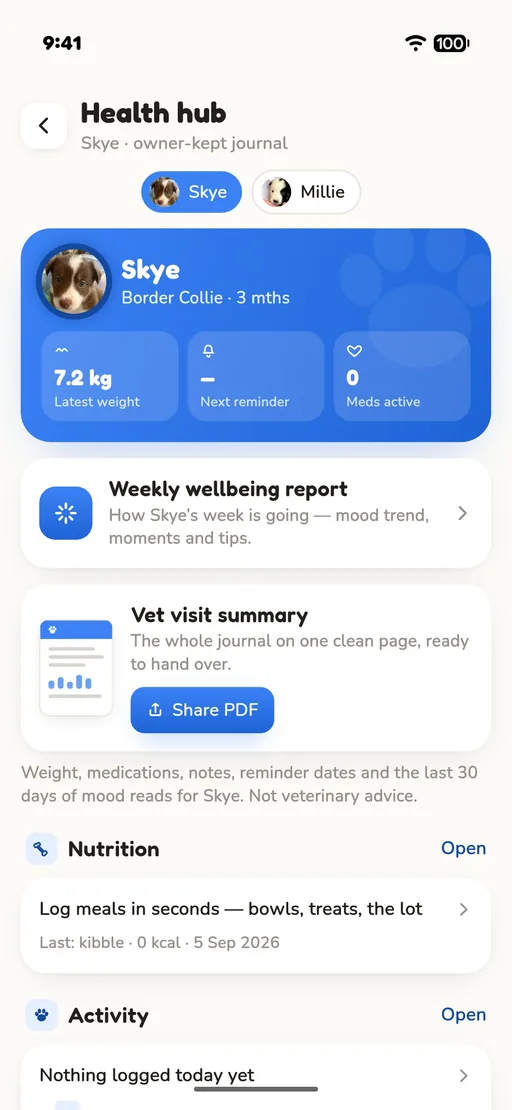
The Health Hub's shareable PDF gathers your dog's owner-kept journal. Your practice keeps the medical record1.
Start with the question you would hate to forget. Then gather the dates, changes and records that might help you explain it. You do not need a perfect diary before asking for help, and the document should never become another obstacle between your dog and care.
Prepare the history, rather than racing the clock
A study published in 2014 timed 182 consultations involving 203 animals at two practices over two weeks. The median was nine minutes and forty-nine seconds, and nearly half exceeded the ten-minute slots3.
That is a historical convenience sample, not a current national appointment allowance. It excluded work such as notes written before or after the client was in the room. The authors explicitly questioned whether the sample represented UK first-opinion practice3.
The practical reason to prepare is simpler than a stopwatch: you want to explain what you know and remember what you wanted to ask. Tell the practice your main concern when booking, and ask how to arrange enough time if you have several things to discuss.
Dogoos's preparation guide suggests recording when something began, how often it happened, changes around that time, and anything already tried. It also recommends writing your main question first4.
Imagine having two versions of a note. One says that the dog has been different for ages. The other states when you first noticed the change and which occasions you remember. You do not need to decide what those details mean before sharing them with the person examining your dog.
Fill the journal with what you actually know
The everyday-care walkthrough starts with choosing the dog in Health. Add the date, details you know and a useful note. It says to record medication instructions and doses given by your vet, and to correct a saved entry if you mistype5.
Separate an observation from an explanation. You may know that an episode occurred after a particular activity; that does not make the activity its cause. If you are uncertain about the date, say so in your description rather than creating a precision you do not have.
For a shared pack, check what another carer has already recorded. Shared dogs have shared care records, and the walkthrough recommends checking existing entries before adding a meal or medication record5.
You could ask the other person to read your account before the visit. They may remember a useful detail, or point out which part they did not witness. Keep those differences clear. A combined account is more useful when you can still explain who saw what.
Know what fits on the summary
The Health Hub describes these limits1:
| Record | Printed scope |
|---|---|
| Owner notes | Newest fourteen within ninety days |
| Weight table | Newest six weigh-ins; the curve uses the wider history |
| Current medications | Up to twelve |
| Reminders | Up to twelve |
| Mood reads | Last thirty days, where available |
Check whether an older observation you want to discuss falls outside the printed selection. A compact summary is not the same as the whole history. Keep the original note available if it matters to the question you are bringing.
The mood section counts reads that passed the quality check and labels their AI-estimated context with the number of reads and average confidence. Medication wording appears under Dose (as recorded by owner), and reminder dates defer to the practice's records1.
You do not need to make an empty section look complete. Bring the history you have and explain what is missing. If you did not record something at the time, an honest recollection is different from a dated entry made then.
Use an ordinary video as supporting information
The preparation guide recommends using your phone's ordinary camera for a visible concern rather than a Dogoos read. Health notes contain text and a date; videos remain in the camera roll, so bring them separately4.
A video study selected one hundred clips of sudden episodic events in dogs and cats. After exclusions for missing ratings, fourteen vets assessed eighty-three clips. Agreement about whether an event was an epileptic seizure was only fair, with a kappa of 0.406.
This measured agreement between observers, not diagnostic accuracy against a gold standard. Most selected clips came from YouTube, and clinical histories and diagnostic work-ups were not supplied. The authors cautioned against relying on footage alone6.
It was not a trial showing that adding this PDF improves a diagnosis, and it does not describe every kind of symptom video. The useful message is to bring context alongside footage, not to ask either the camera or an app to settle the medical question6.
If you already have a recording, find it before the appointment so you can open it without searching through the whole gallery. Ask the practice how they prefer to receive it. Keep helping the dog ahead of getting a better shot.
Check, then share the actual document
Share PDF builds the summary on your device from the journal already there, works offline and does not use a read. The result goes to the ordinary share sheet1. Check the file before choosing where to send it.
The care walkthrough specifically recommends reviewing dates, medication details and corrected notes before sharing5. Read those fields as carefully as you would a message you are sending directly to the practice.
Before handing it over
- Is this the correct dog's document?
- Are the dates and latest weight what I intended?
- Have I checked the medication wording against the instructions?
- Is an important older observation outside the printed notes?
- Do I have any useful ordinary video separately?
- Have I checked the destination before sharing?
When the file is ready, make the handover straightforward. Tell the vet your main concern and which part of the history you thought might help. You can offer the document without expecting every line to determine the consultation. The professional can decide which details need following up.
Bring questions, and leave interpretation to the vet
Dogs Trust recommends a veterinary check for changes in normal behaviour, new responses or changes in eating, drinking, sleeping and toileting. It notes that diaries, observations and videos can help the appointment7.
Ask what you should watch for next, when to seek further help and whether a follow-up is needed. If an instruction is unclear, ask the practice to explain it before you try to enter it into an app. A neatly typed uncertainty is still an uncertainty.
Keep the next part of the record useful
The preparation guide recommends keeping relevant packaging, recording the weight taken at the visit, preserving the prescribed dose wording and setting the agreed recheck4. Use the instructions you were actually given rather than inventing a schedule from a default.
After the appointment
- RecordKeep the instructions and details you were given
- CheckAsk the practice about anything unclear
- PrepareMake the agreed follow-up easy to find
- NoticeContinue describing what you observe between visits
The summary can help you arrive with your part of the story organised. The next useful step is whatever the consultation establishes, whether that is monitoring, an investigation or a treatment plan. Keep the document beside that plan as a record, rather than treating it as the plan itself.
Sources and further reading7 sources
The small numbers in the article link to the source behind each fact. Sources open on their own websites.
- Health Hub: the journal your vet can read in seconds
- Getting emergency vet care for your pet
- Consultation length in first opinion small animal practice
- Vet visit prep: what to write down before you go
- Meals, walks and daily care
- Inter-observer agreement of canine and feline paroxysmal event semiology and classification…
- How to understand your dog's body language