

In this article
The first rocket of the season goes up at ten past seven, and your dog is under the kitchen table before it bursts. Was she this bad last year? You think so. Maybe worse. By January most of us can't say, because the nights blur into one.
That matters, because in one large owner survey, firework fear eased in many dogs and got worse in many others1. Here is a plan built from free Dogoos tools: a few calm reads now, a dated note after each firework night, and a summary to take to the vet.
Why it's worth keeping track
Firework fear is common, and it doesn't stand still. An online survey run from the University of Bern, with owners in many countries including the UK, covered 1,225 dogs and found 52% at least partly affected. Where owners knew when the fear began, the commonest start was before the first birthday, in 45% of dogs1.
When the owners of 664 fearful dogs rated how the fear had changed over the years, the answers split three ways1.
How owners said their dog's firework fear had changed
It was a self-selected sample, spread partly through dog-related Facebook groups, and every answer is an owner's impression1. Even so, this year may not look like last year. Watch recovery too: almost three-quarters of the fearful dogs were back to normal by the next morning, but 10% took up to a day, 12% up to a week and more than 3% several weeks or even months1.
Before the season: catch a few ordinary evenings
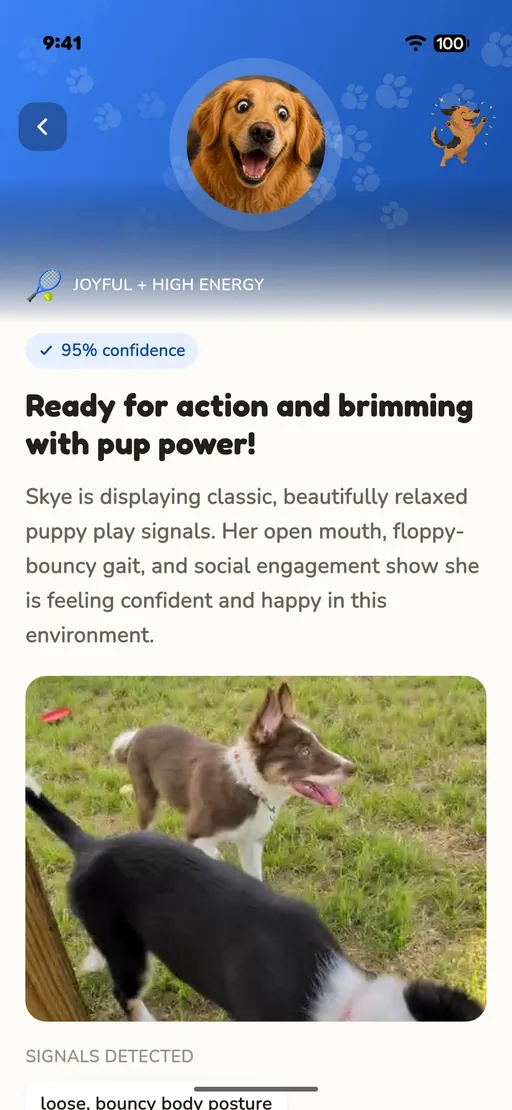
A read is the quickest way to put an ordinary evening on record. Tap the paw, film five seconds of your dog, and Dogoos comes back with one of six moods (Playful, Engaged, Uncertain, Puzzled, Startled or Appeasing), a confidence figure, and a score for how much the face, body and sound each carried2. The free plan includes one read a day2.
Over the next week or two, take a handful on calm evenings, around the time fireworks tend to start, in the room your dog will use on firework nights. Put a lamp on and get the whole dog in frame, the two things Dogoos says make the biggest difference2. Each read lands in Mood history by date5. A read is a best guess at how your dog seems in one short clip, with its confidence on show, and never a diagnosis2. What it gives you is a dated snapshot you can repeat.
While you're at it, write a “before” note in the Health Hub about a normal evening: where your dog settles, how they eat, how the last walk goes. Notes are dated and in your own words3.
Now is also the time for the RSPCA's list: a safe den your dog can always reach, daylight walks, windows and curtains closed, and a microchip in place4. For the longer term, the charity suggests getting your dog used to recorded firework sounds, played quietly at first and turned up by degrees, with a treat after each loud noise, starting well before the season4. In the Bern survey, dogs trained before any fear appeared were far less affected, by their owners' account1.
On the night: comfort first, record second
When the bangs start, your dog comes before the app. The RSPCA says let a frightened dog pace or hide, and don't coax them out: they are trying to find safety4. Stay close if you can, act as you usually do, and comfort them; never shout4.

So treat a firework-night read as optional. If your dog is out in a lit room and you can film without fuss, take the day's read. If they are tucked in a blacked-out den, as the RSPCA suggests4, leave them be. A dark clip gets a “Couldn't read clearly” card2, and only reads that pass that check count towards the summary's mood chart3.
To show a vet or behaviourist what happens, use your phone's ordinary camera for a few seconds: a read keeps one still photo at most, and a Health Hub note has no photo slot6. Only film if it doesn't mean leaving your dog alone.
Note when the street goes quiet, too. In England and Wales the law stops most people using adult fireworks between 11pm and 7am, with later finishes on permitted nights: midnight on 5 November, and 1am after New Year's Eve, Diwali and the first day of Chinese New Year7. That rule covers England and Wales only7, so if you live in Scotland or Northern Ireland, check the rules there.
One firework night, start to finish
What to write in each note
One note per firework night is enough, written that night or next morning while the details are fresh. Keep it short and use times and plain words: “shook under the table from 7.10 to 9.40” tells a vet more than “bad night”6.
What to put in each firework-night note
- The date, and roughly when the bangs started and stopped
- What you saw: shaking, panting, yawning, hiding, pacing, barking
- Where your dog went, and whether that place is new
- How long they took to settle, and whether breakfast and the morning walk were normal
- What you tried: the den, music, closed curtains
- The mood and confidence of the day's read, if you took one
The RSPCA lists excessive panting and yawning among the subtler signs of stress4, and in one small clinic study, shaking and hiding were the commonest signs of noise sensitivity8. You don't need to name a feeling. Write what you saw.
Short of time? Tell Ask Rex in a sentence and he can file the note for you3. The journal also opens in a browser at app.dogoos.com, though reads can only be taken in the Android phone app6. One limit to plan around: the vet visit summary prints your newest fourteen notes from the last 90 days3. In a long season, write one short note summing up the earlier weeks just before the appointment, so they still reach the page.
Reading the season back
After a week or two, read your notes month by month3 with Mood history beside them5. Three questions do most of the work.
- Is settling taking longer? Compare the gap between the last bang and a settled dog across the nights.
- Is the fear spreading? A dog who hid during the bangs and now avoids the garden after dark has changed.
- Is the next morning different? Most fearful dogs in the Bern survey had recovered by then1, so a dog still unsettled at breakfast is worth telling your vet about.
Set firework-night reads beside your calm evenings too, but lightly. Dogoos's own advice is to compare patterns over several days and never to treat one read as a diagnosis5.
Taking it to the vet
Talk to your vet before the busiest nights if you can. The RSPCA says your vet can advise on pheromone diffusers, may in some cases prescribe medication, and can refer you to a clinical animal behaviourist4. Plenty of owners haven't asked theirs: in the Bern survey, only 36% of owners of fearful dogs had consulted a vet1.
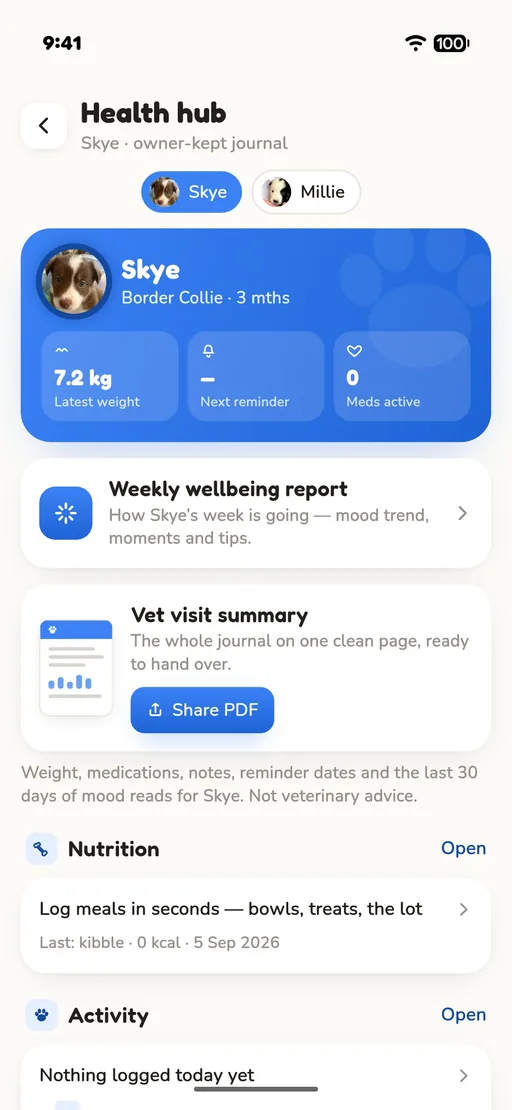
Open the Health Hub and tap Share PDF. The vet visit summary builds on your phone with your notes from the last 90 days and a bar for each mood found in the last 30 days of reads, under a line saying how many reads they come from and their average confidence3. The bars don't say which night was which; your dated notes do. Every page is footed “Journal kept by the owner in Dogoos. Not veterinary advice.”3
Mention it if the fear is new in an adult dog, or spreading to new places. In a study of 20 noise-sensitive dogs seen at the University of Lincoln's animal behaviour clinic, those with musculoskeletal pain had started showing the problem nearly four years later on average, and their fear had more often spread to places linked with the noise8. It is a small study showing a link, not a cause, but its authors advise vets and behaviourists to check such dogs for pain8.
Come January, you won't need to remember how she coped on the fifth of November. It will be there in a few dated lines, ready to hand across the consulting table.
Sources and further reading8 sources
The small numbers in the article link to the source behind each fact. Sources open on their own websites.
- Not a one-way road—Severity, progression and prevention of firework fears in dogs
- How a Dogoos read works: five seconds, three signals
- Health Hub: the journal your vet can read in seconds
- Keeping dogs, cats and other small pets safe during fireworks
- Keepsakes, History and Stories
- Vet visit prep: what to write down before you go
- The Fireworks Regulations 2004, regulation 7: prohibition of use of certain fireworks at night
- Noise Sensitivities in Dogs: An Exploration of Signs in Dogs with and without Musculoskeletal Pain Using Qualitative Content Analysis