

In this article
You say something to your dog and the head tips sideways, as though a very small committee is considering your proposal. It is one of those expressions that makes you want to keep talking. Battersea includes an interested head cock among the signs you may see in a relaxed dog who is happy to interact1.
Here is what the toy-name experiment measured, how to read the expression in context and how to recognise the different sort of tilt that needs a vet. You can enjoy the moment without turning it into a translation.
The toy-name experiment
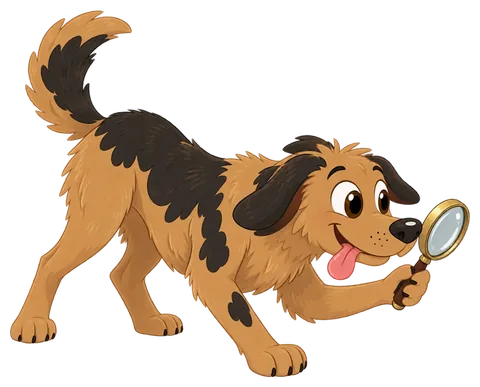
Researchers watched 40 dogs being asked to fetch named toys from another room: seven gifted word learners and 33 typical dogs. In the first experiment, the gifted group tilted in 43% of trials, compared with 2% for the others. One gifted dog never tilted at all2.
The authors suggest that tilting may accompany attention to meaningful sounds, perhaps matching a name with a remembered object. Those are explanations to investigate, not thoughts the researchers measured. Their tests involved toys; they did not establish why dogs tilt in every other situation2.
That is a useful boundary to keep. The expression can be fascinating without becoming a translation. When your dog tilts at a question about the weather, you can enjoy having an audience without assuming you have received an informed opinion on the forecast.
Your dog has nothing to prove
The word-learning project behind the head-tilt analysis also explains why this should not become a parlour test of intelligence. Its original comparison included 34 dogs without an established toy vocabulary and six already known to recognise toy names. After a programme of training, only one of the first group joined the six successful learners5.
Dogs in both groups were keen to retrieve toys. Most of the unsuccessful word learners still fetched enthusiastically; they struggled to choose using the name alone. The authors describe an unusual skill in a particular area, and acknowledge that other training methods might produce different results5.
So picking up the wrong toy need not spoil the game. You went to the cupboard for a bit of shared fun, not to administer an entrance exam. A dog who brings a sock when you requested a rabbit has still found something you can enjoy together.
For everyday learning, the RSPCA recommends patience, rewards the individual dog enjoys and brief, regular sessions. Dogs learn at different rates6. Let that advice set the tone if you try teaching a toy name. You do not need a growing vocabulary, a perfect retrieve or a photograph of the perfect tilt to make the time worthwhile.
Does left or right reveal anything?
In the head-tilt study, individual dogs tended to favour the same side across tests. The owner's position did not explain the direction, and the sample was too small to establish a population-wide preference2. That leaves no sound basis for a home rule such as left means puzzled or right means happy.
Other researchers have studied a different movement: turning the head towards a sound. In an experiment with 30 pet dogs, recordings of human emotional sounds produced different directional patterns. Fear and sadness sounds prompted a leftward bias, while happiness sounds prompted a rightward one7.
Those dogs were eating between two speakers, with their owners standing behind them. The researchers measured turns towards the speakers, alongside behaviour and heart activity. They were not measuring an ear-down tilt while an owner named a toy7.
A useful way to read a science headline is to ask what the researchers actually counted. A turn and a tilt can look close enough in a quick video, but swapping one for the other changes the claim. Neither experiment supplies a running commentary on what your dog thinks of your conversation.
Read the dog around the expression
Battersea's advice is to get familiar with your own dog's relaxed appearance, allowing for differences in ears and tails. Soft eyes and a loose, gently moving tail can accompany that interested head cock. Body language can also ask us to stop an interaction or give more space1.
Dogs Trust makes the wider point: a single body part cannot fully explain a dog's feelings. The situation matters, and signals can be mixed. A wag, for instance, can accompany worry as well as excitement3. So widen your attention beyond the charming angle of the ears.
If you want to understand the moment better, a short video can be more useful than a still picture. Dogs Trust suggests having someone film an interaction so you can watch the body language back3. Try looking once at the face, then again at posture and movement. You are collecting a fuller picture, not trying to earn a mark for guessing the right emotion.
Make listening time enjoyable
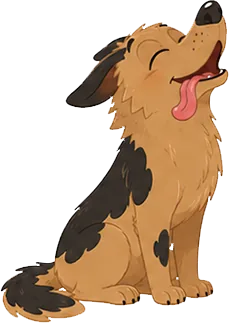
Start with something your dog already likes doing with you. It could be a familiar cue followed by a favourite reward, or a little play with a toy. The RSPCA's training guidance supports a quiet setting, short sessions and finishing with something the dog knows6. There is no need to make an odd noise just to produce a reaction.
Here is a small observation game of our own. Think of it as a prompt to pay attention, with no target number of tilts and no score to beat.
Watch without testing
- Choose an ordinary momentUse a calm interaction your dog already enjoys.
- Say something familiarNotice what happens without repeating it to chase a reaction.
- Look more widelyInclude posture, ears, eyes and movement in your notes3.
- Keep it pleasantUse rewards your dog likes and end while the session is still enjoyable6.
You might write down the word you said, where you were and whether the dog wanted to carry on. An entry that reads 'no tilt, fetched duck, had fun' is a perfectly good result. The point is to notice your own dog, rather than make their afternoon fit a laboratory finding.
When the head stays to one side
A brief listening tilt is different from a head that remains cocked. PDSA advises contacting your vet about a persistent tilt even when there are no other symptoms. Ear infections and vestibular disease, which affects balance, are among the possible causes4.
Changes to tell your vet about
Your vet may examine the ears and nervous system and recommend other tests according to the symptoms. The cause determines the treatment and outlook4. Tell the practice when the tilt began and what else you have noticed; do not assume that a persistent tilt is the same expression you see during a chat.
For the passing, comfortable tilt, you can leave a little room for mystery. Keep talking, keep watching the rest of your dog, and enjoy the company.
Sources and further reading7 sources
The small numbers in the article link to the source behind each fact. Sources open on their own websites.
- Understanding your dog's body language
- An exploratory analysis of head-tilting in dogs
- How to understand your dog's body language
- Head tilt in dogs
- Word learning dogs (Canis familiaris) provide an animal model for studying exceptional performance
- Dog training
- Lateralized behavior and cardiac activity of dogs in response to human emotional vocalizations