

In this article
The poo is done, the bag is ready, and your dog adds a finishing flourish: a few emphatic backward kicks that send grass towards your shoes. It looks deliberate. Whether the intended audience is you, another dog or nobody in particular is a harder question.
Researchers call this ground scratching. Work on dogs' marking behaviour and paw scent gives us clues, but a scrape in the grass does not come with a reliable translation. There is also a separate, much-shared question about dogs lining themselves up like tiny toilet compasses.
A conspicuous finish to a quiet activity
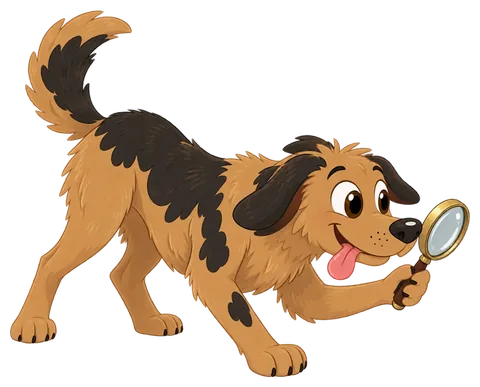
In an observational study, Marc Bekoff followed 13 identified, free-ranging male dogs. He recorded ground scratching alongside different kinds of urination and leg-raising displays. Scratching was more likely when other dogs were in sight, suggesting a possible visual component1.
It did not follow every urination. Scratching also sometimes followed a raised-leg display without detectable urine being released. Bekoff proposed a combined signal involving the action, visible scratches and possible scent from between the toes. The study did not decode a single message for every scrape1.
He also noted that the deposit was rarely hit directly by the scratching. That makes “covering it up” an incomplete explanation of the pattern described, although his study primarily concerned urine-related sequences rather than a controlled test of scratching after pooing1.
A visible flourish and a lasting mark are different things to investigate. Another dog could see the movement while it happens, encounter the mark later, or do neither. The presence of a possible signal does not tell us exactly what any receiver understood.
Paw scent is real, but the message is not decoded
A Norwegian experiment presented dogs with scent swabs collected from male and female dogs' paws, plus swabs carrying ground scent as a control. Forty-eight pet dogs took part, with 34 included in the final analysis after exclusions. All were unneutered2.
Male subjects sniffed male paw scent longer than the control, without a clear difference between male and female scent. Females showed no clear sniffing-duration difference. The authors remained uncertain whether paw scent allowed dogs to identify the donor's sex2.
The samples came from several areas of the paw, including between the toes. This supports interest in scent associated with another dog's feet. It does not show how much scent a backward scrape leaves, how long it lasts outdoors or the exact information a passing dog obtains2.
Think of that as evidence for another part of the puzzle. A laboratory scent presentation and a paw scraping through damp turf are related questions, rather than the same experiment performed in different places.
The poo compass is a separate question
One study collected toileting observations from 70 dogs overall. Defecation data came from 55 dogs, and urination data from 59. Researchers reported a preference for a north–south body axis during defecation when changes in the Earth's magnetic field were particularly small3.
The important condition was magnetic stability, rather than every toilet trip. The field-based analysis was developed after an initial analysis produced ambiguous results. Observers measured freely moving dogs outdoors, away from prominent structures, and the study did not measure ground scratching3.
The paper therefore cannot explain why your dog kicks afterwards. It also leaves the mechanism and purpose of the reported alignment unresolved. A north–south axis allows either end to face north; it is not a rule that every dog must face the same direction3.
Later researchers observed 52 dogs in five urban parks in Lyon and found no detectable magnetic alignment. In their pooled data, orientation instead related to the parks' layout, with that relationship clearest for urinating dogs. They analysed one observation per dog4.
This was a replication of a later urban-park report, rather than an exact repeat of the original calm-field setting. The authors acknowledged that their findings did not rule out magnetic sensitivity. Their own observations were not blinded to the question being studied4.
You do not need a compass to make an ordinary toilet break comfortable. These findings are research questions, not instructions to turn your dog to a preferred bearing or a new reason to worry about where they stand.
Read the rest of the dog too
Dogs Trust advises looking at the whole body and the situation. The same movement can mean different things in different circumstances. A single part of the body does not fully explain how a dog feels5.
For a dog who scrapes when another dog approaches, look beyond the paws: are they stiffening, trying to move away or showing other signs of discomfort? Those observations are more useful than deciding the kicking alone proves confidence, aggression or ownership of the park5.
Give a worried dog more distance from what concerns them. Dogs Trust describes the comfortable distance as individual and changeable, depending on how intense the situation feels. There is no fixed safe distance that suits every dog on every walk5.
It can help to describe the sequence plainly: “She scratched after weeing, then watched the approaching dog.” That leaves the meaning open while preserving what you actually saw.
Keep the walk enjoyable and manageable
Dogs Trust recommends allowing time for sniffing and offering activities suited to the individual dog's health, abilities and preferences. A walk can include a toy game, a suitable food search or familiar training, alongside ordinary exploration6.
Its guidance is to watch whether the dog seems engaged, confused, frustrated or worried and adapt the activity. If something in the environment worries them, calmly lead them away. Enrichment should provide a suitable opportunity, rather than become another task they have to endure6.
Applied to flying turf, the practical aim is modest: choose places and space where the walk works for your dog and the people around them. A different patch of ground or a calmer stretch of path may be easier to manage than trying to interpret each kick.
A calmer pause
The bag is still your part
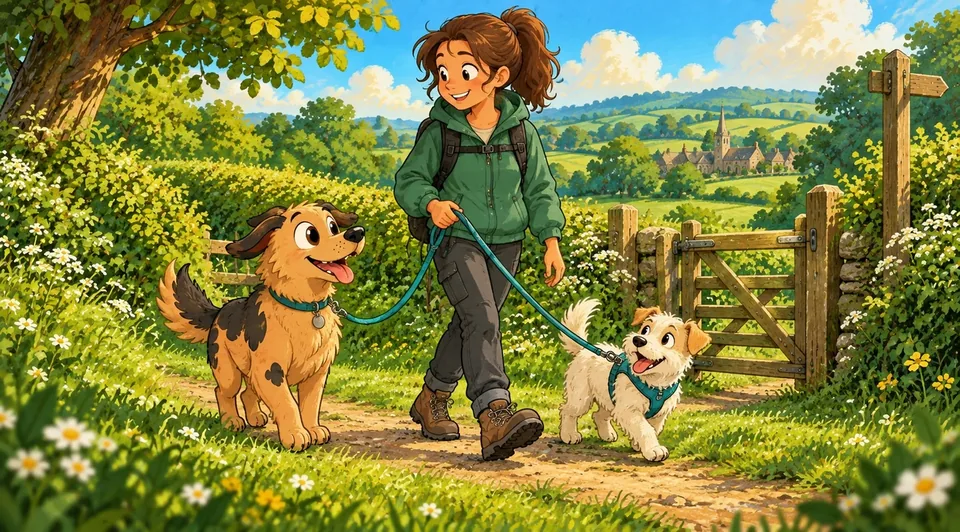
The Countryside Code for England and Wales asks visitors to clean up dog poo, use a public waste bin or take the bag home. It also advises following local signs, avoiding damage or disturbance and keeping dogs under effective control7.
A scratched patch does not replace that clean-up. Have the bag ready, keep track of where the poo landed and carry it to an appropriate bin. Do not leave a filled bag behind with the intention of collecting it on the way back7.
There is room for a dog to be interesting and for the person at the other end of the lead to remain considerate.
When the feet deserve attention
A familiar scratch-and-move-on sequence is different from noticing a dog limp, hold up a foot or repeatedly lick one spot. PDSA lists those changes among signs that may indicate pain or a leg problem. Contact your vet about limping or stiffness8.
Possible causes include claw injuries, something stuck in a foot, muscle injuries and arthritis. These cannot be distinguished by how dramatically a dog kicked the grass. Describing the change in their movement gives the practice more useful information than labelling it a toilet ritual8.
The entertaining part can stay entertaining. You can appreciate the flourish, give the dog suitable space and notice when their usual pattern changes, without pretending that every flying clod carries a message we have already translated.
Sources and further reading8 sources
The small numbers in the article link to the source behind each fact. Sources open on their own websites.
- Ground Scratching by Male Domestic Dogs: A Composite Signal
- Conspecific recognition of pedal scent in domestic dogs
- Dogs are sensitive to small variations of the Earth's magnetic field
- No evidence for magnetic alignment in domestic dogs in urban parks
- How to understand your dog's body language
- Enrichment activities to keep your dog entertained
- The Countryside Code: advice for countryside visitors
- Limping and stiffness in dogs