

In this article
The doorbell goes, and before your friend is through the door your dog is up on their back legs: paws on a clean coat, nose aimed at a face, tail going like a windmill. You apologise, ease them down and laugh it off. Then the next guest comes in, and it all happens again.
If that sounds familiar, you have company. When a large long-term study of dogs in the UK and Ireland asked owners to describe anything their young dog did that they found a problem, between 5% and 8% named jumping up at each age from six to 18 months, second only to barking1. Owners had to think of it unprompted, so the researchers expect the true figure to be higher1. The good news is that a calmer hello can be taught. Here is why dogs jump, why the usual fixes fall flat, and a kind plan for greetings with four paws on the floor.
Why dogs jump up at people
Dogs jump up for different reasons, and the reason shapes the fix. Dogs Trust's list covers excitement, frustration, stress, anxiety and habit2. An excited dog might have a fast-wagging tail and a loose body. A frustrated one, held back on the lead from a cat across the road, may jump at whoever is holding the lead, and a worried dog may jump up at people it knows, looking for reassurance2. Habit keeps any of these going: if jumping up has a good outcome for your dog, it is likely to be repeated2.
The same long-term study, called Generation Pup, could not show young dogs growing out of it. Between six and 18 months, reports of barking, pulling on the lead and recall problems changed significantly, but reports of jumping up did not1. The researchers group it with pulling and recall as a training issue1, which puts it within your reach.
What your dog gets out of a jump
A US society of veterinary behaviour specialists puts it plainly in a position statement: dogs jump on people because when they do so, they get attention, not out of any wish for higher rank4. Speaking, touching and eye contact all count, and any attention, even saying "no", can reinforce the jumping2, 3.
The prize is not always attention, though. Researchers at Queen's University Belfast studied five pet dogs who jumped up at their owners as they came in through their own front door. Short tests showed what the jumping earned: for four dogs it was a ball or a toy, and only one was jumping for attention5.
Four of the dogs went on to a second stage, in which owners handed out that toy or attention on a timer, jump or no jump. Jumping fell clearly in two, less clearly in a third and not in the fourth5. Five dogs is a tiny sample, and the authors call their results tentative5. The lesson worth keeping: notice what happens straight after a jump, because that is what your dog is working for.
Why pushing, kneeing and shouting are poor fixes
When a dog lands on you, pushing them off or telling them to get down feels natural. Dogs Trust warns that pushing your dog down, shouting at them or punishing them in any way can make the behaviour worse2. Some dogs find being told off rewarding; others find it distressing, and that anxiety might make them jump up even more2.
What about the knee in the chest, an old standby? In a US survey published in 2009, 140 owners whose dogs were booked in with a veterinary behaviour service listed what they had already tried. Twenty-nine had kneed their dog for jumping up: 15 said it made no difference, 13 said it helped and one said it made things worse6.
These are the impressions of a small group of owners, and the survey did not say whether "effect" meant the jumping or how the dog reacted6. Still, more than half saw no benefit, a poor record for a quick fix. And as the researchers note, correction alone does not reward the behaviour you want, so it is an inefficient way to teach a dog what to do6.
When your dog jumps up at you
Do
In a later statement on humane training, the same society says everyday problems such as jumping can be managed by setting up your dog's surroundings well and rewarding the responses you want7. In other words: stop the jump paying off, and pay for something better.
Teach a better way to say hello
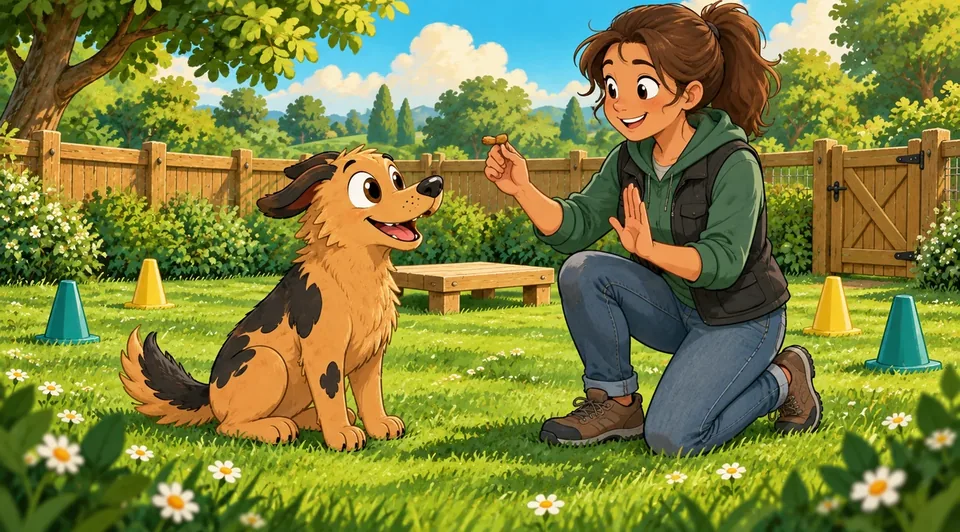
Start by choosing what your dog should do instead: a sit, carrying a toy, touching their nose to your hand, or keeping all four paws on the ground2. Teach it away from visitors first, practising a sit before meals, before the lead goes on and at calm moments through the day3.
Practising greetings with a helper
- Set up somewhere calmHome or garden, after a toilet break and some exercise, with your dog on their lead2
- Bring in a helperA friend or relative your dog is relaxed around walks towards you. If your dog can't focus, start further away2
- Ask earlyCue the sit before your dog starts to jump, and reward them the moment they sit2
- Reward lowDrop treats to the floor; food offered near your chest or face can invite a jump3
- If they jumpStay calm and wait for it to stop; your helper can move away, or you can take a break2
- Add a gentle strokeOn the shoulder or chest, since a hand over the head is hard not to jump at, and only while your dog sits calmly2
- Build it upDifferent people, then busier places such as the park or a walk2
How long will it take? Dogs Trust says many dogs improve within a couple of days or weeks, but that it will likely take a few months of regular practice, especially in busy or new situations2. Expect a wobble too: when jumping no longer works, your dog may try harder before giving up, which Battersea calls a normal part of learning3.
Everyone has to play by the same rules, because a dog who gets attention for jumping is likely to jump again and again2. Get family and friends on board, and brief visitors before they arrive2. Then get in first: be quick to interact with your dog before they jump2, a little like the owners in that small study, who handed over the toy as soon as they came in5.
Visitors while you are still training
Visitors will not wait for your training to finish. Greeting people is a major trigger for jumping, so planning ahead makes a huge difference, as Battersea puts it3. The aim is to stop your dog rehearsing the jump while the new habit grows.
Before the doorbell goes
- A stairgate or closed door to keep your dog separate as people come in2
- A houseline, a thin lead without a loop, clipped on before guests arrive so the lead isn't linked with visitors3
- A handful of treats to sprinkle on the floor and keep your dog's nose down2
- A long-lasting chew or enrichment game to keep your dog busy as visitors arrive3
- A word with guests: no fuss until all four paws are on the floor2
When the jumping comes from worry

Not every jumper is a party animal. Anxious dogs may jump up at people they know to seek reassurance and security, sometimes with a tucked tail and panting2. A dog who only jumps at children might fear them, and some dogs jump if they are in pain, or to make themselves bigger while they say "go away!"2.
These dogs need confidence more than correction. Keep a safe distance from people, reward your dog for seeing them and staying calm, and close the gap gradually while they stay relaxed2. Your dog doesn't have to say hello to everybody, especially if they are worried2. A very anxious dog may also need space to move away, so Battersea suggests avoiding a lead for them when someone comes over3.
When to get help
Talk to your vet first if your dog's behaviour has recently changed, or they seem more fearful in general or seek comfort and reassurance more often2. A vet can check whether a medical problem is playing a part, even when there are no obvious signs of pain or illness2, 7.
If your dog jumps because they are anxious or frustrated, or shows any aggression, a qualified behaviourist can help change how your dog feels before teaching a new habit2. The Animal Behaviour and Training Council keeps the UK's national register of assessed trainers and behaviourists8, and Dogs Trust's behaviour team gives free advice by phone2.
Give it a few weeks of short, cheerful sessions and the doorbell starts to mean something new: a sit, a treat on the floor and a hello your guests will be glad to return. Their coats will thank you too.
Sources and further reading8 sources
The small numbers in the article link to the source behind each fact. Sources open on their own websites.
- Owner-Perceived Undesirable Behaviours in Young Dogs and Changes with Age
- How to stop your dog jumping up at people
- How to train your dog not to jump up
- Position Statement on the Use of Dominance Theory in Behavior Modification of Animals
- Using Principles from Applied Behaviour Analysis to Address an Undesired Behaviour: Functional Analysis and Treatment of Jumping Up…
- Survey of the use and outcome of confrontational and non-confrontational training methods in client-owned dogs showing undesired behaviors
- Position Statement on Humane Dog Training
- The Animal Behaviour and Training Council: Promoting Excellence in Animal Behaviour and Training