

In this article
You have ordered a coffee. Your dog is waiting to see which of the other customers needs supervising. A quiet drink together is a pleasant ambition, but the lunchtime queue is quite a place to begin practising it.
Dogs Trust's settle exercise starts somewhere quiet and rewards increasingly relaxed behaviour. The aim is for a dog to learn to settle without constant instructions, with distractions introduced gradually.1
Rest is part of the day

Dogs Trust gives 12 to 14 hours a day as general adult sleep guidance, with puppies and older dogs often needing more. Individual needs vary. It recommends suitable exercise, enrichment, social time and chances to rest, and notes that both too little activity and overtiredness can make settling difficult.3
There is research linking learning and sleep, although it does not prescribe a café routine. In a 2017 experiment, 15 adult pet dogs learnt unfamiliar words for familiar sit and lie-down actions. Researchers recorded their sleep with EEG and found changes in sleep activity after learning, with better performance after the recording period.4
That was a small command-learning study, not a trial of settling on blankets. Performance improvement was not related to sleep duration in that experiment. You cannot turn it into a rule that a dog needs a particular nap length after every practice session, or that extra sleep will teach a dog to enjoy crowds.4
For your own planning, look at the whole ordinary day before adding another training task. When is the house quiet? When are you usually trying to cook, work or greet visitors? A settle is more useful when it fits that day than when it exists only as an ambitious item in a notebook.
Make the quiet spot comfortable
The RSPCA recommends a comfortable safe space away from regular traffic, play and noise, with freedom to enter and leave. Do not force a dog into it or disturb them while they use it. A quiet resting place is something the household protects, not just a blanket that happens to be on the floor.2
Choose a place you can realistically leave alone. A bed beside the busiest doorway may look tidy from your chair, but think about the position from floor level. This is a suggested way to inspect the setup: sit nearby and notice what would pass, rattle or loom over the resting area.
The RSPCA's guidance puts comfort and undisturbed rest ahead of elaborate equipment. Clean the space when the dog has left it, and make sure everyone understands its purpose. Children and visitors need the same arrangement as the person who bought the bed.2
Begin the blanket exercise
Dogs Trust begins with you sitting quietly, your dog on a lead and a blanket on the floor. Reward without talking.1
Reward the change you can see
- Start smallQuiet standing or disengaging from you may be the first success.1
- Notice relaxationGradually reward lying down, shifting weight or resting the head.1
- Build time gentlyAdd a little time between rewards over several sessions.1
- Make distractions easierIncrease distance or reduce interest if your dog cannot settle.1
The method moves towards off-lead practice in a safe setting and then different places. Resist continually instructing the dog. The exercise is intended to build self-chosen relaxation, with progress adjusted to the individual.1
Your first useful note might be that your dog stopped watching your hand and sniffed the blanket. That is a description you can build from. You do not need to record a full afternoon asleep under a table before deciding the practice was worthwhile.
Choose rewards that fit a quiet task
Battersea advises matching rewards to both the dog and the behaviour. It recommends food for calm settling, while toys may suit energetic work such as recall. Dogs differ in what they value, and one food or toy may be much more interesting than another. Notice the effect of what you offer.5
It also suggests more valuable rewards for new or complicated tasks and distracting places. This is practical guidance, not a reason to keep making the situation harder. If the dog cannot engage with the exercise, look at the task as well as the contents of your treat pouch.5
For instance, after a session you could write down what you rewarded and what happened immediately afterwards. Did you see a comfortable shift of weight, or did you find yourself reaching into the pouch repeatedly while waiting for something else? That is a useful question to take to a reward-based trainer who can watch the exercise with you.
Practise the home events separately
Dogs Trust's visitor guidance separates several skills: getting comfortable with knocking and doorbell sounds, going to bed on cue, and settling while guests enter. Its bed exercise rewards going to a comfortable bed, adds a word and gesture, then gradually builds distance and time. If the dog struggles, make the step easier.6
That is different from expecting one blanket session to cover the arrival of a favourite person. You might choose one ordinary household moment as a practice goal, such as sitting while another adult reads nearby. This is a suggested example, not a progression test with a compulsory deadline.
For visitor practice, Dogs Trust recommends preventing unexpected knocks from disrupting the sound exercises. It suggests enjoyable food activities to help the dog remain settled, then introduces real arrivals after preparatory work. A helper can make the arrangement predictable; a surprise delivery cannot be expected to follow your lesson notes.6
Plan a public visit around your dog
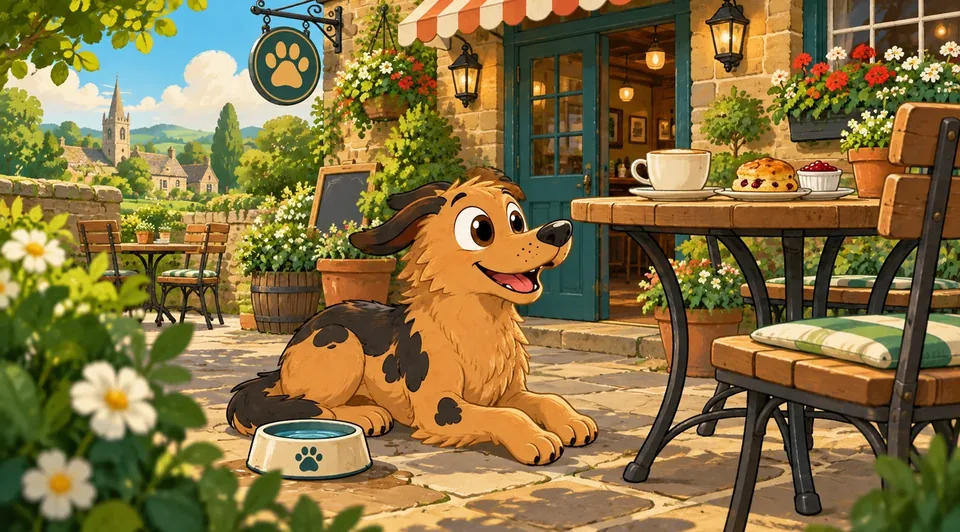
Dogs Trust advises checking what a venue permits, including whether dogs are welcome only outside. It also points out that not every dog feels relaxed when accompanying people to eat or drink. Practising beforehand and bringing a suitable toy or chew can help, but an accredited professional can advise if the dog still does not enjoy it.7
Before choosing the venue, think about how your individual dog feels around unfamiliar dogs, people and busy environments. Dogs Trust uses those questions when discussing whether a trip suits a dog. Permission to bring them along is only one part of the decision.7
Here is an example of a visit plan you can adapt. It is a set of planning prompts, not a research-tested café protocol. Keep the first aim modest enough that you can leave without abandoning a meal or making the rest of the group responsible for your dog.
Questions before leaving home
- Have I checked the venue's dog policy?
- Where could we sit with room around us and a clear way out?
- Have I packed the familiar blanket, rewards and water?
- Who will leave with the dog if the visit is too much?
- Can this be a brief practice visit without other commitments?
When practice is not the next step
Northern Ireland's official welfare guidance stresses that dogs have different rest needs. It recommends suitable activity, supervised toys and chews, undisturbed rest and reward-based training. Seek veterinary advice when behaviour changes, because distress, illness or injury may be involved. A new inability to rest deserves attention alongside the training plan.8
Dogs Trust likewise recommends a vet check if restlessness worsens after exercise or eating, if touch triggers unusual excitement, or if sleep is difficult. Pain and discomfort can interfere with settling. Get individual behaviour support when worry or persistent difficulty prevents progress, starting with the vet where health or sudden change is involved.3
You can choose a quieter outing, or a different arrangement for the dog, while you work out what suits them. A comfortable few moments beside your chair is a useful place to begin; the coffee can wait until the practice and the setting fit.
Sources and further reading8 sources
The small numbers in the article link to the source behind each fact. Sources open on their own websites.
- How to train your dog to be calm, relax and settle
- Create a safe space for dogs
- Helping a hyper or restless dog to calm down
- The interrelated effect of sleep and learning in dogs (Canis familiaris); an EEG and behavioural study
- Training motivations
- How to prepare your dog for visitors
- Everything you need to know about taking your dog on holiday
- Welfare of dogs: normal behaviour patterns