

In this article
Your dog is watching the garden, then turns towards a sound in the hall. A short clip contains a moment of that afternoon. Dogoos can label its interpretation Playful, Engaged, Uncertain, Puzzled, Startled or Appeasing1.
Those six words give you somewhere to begin. Compare the explanation with what you can observe and what was happening around your dog. The questions below help you use each label without making a single movement carry the whole answer.
Playful: check the invitation and the response
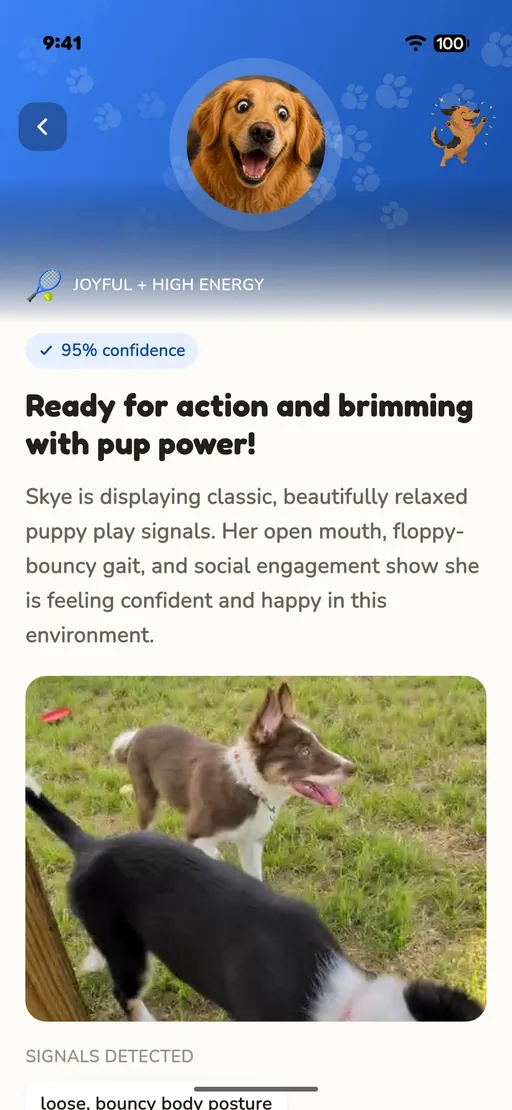
Battersea describes playful dogs as animated, sometimes lowering their front end while their rear stays raised. It also recommends learning the individual dog's relaxed appearance, allowing for differences in ears and tails3. A familiar dog gives you a useful comparison.
Research adds detail to the bow itself. A study of ten dog puppies recorded 136 bows during play. Almost all happened with the partners in each other's visual field, and both partners showed more pauses before a bow than afterwards4.
That supported a role in restarting activity within play. The researchers analysed bows inside ongoing play bouts, excluding those that initiated a bout. These were specially reared puppies, and the study did not establish a universal reading for every lowered front end4.
Dogs Trust describes appropriate play as loose, with breaks, role switching and opportunities for both dogs to participate2. When checking a Playful label, watch the other dog too. An invitation and a willing response are separate observations.
Engaged: ask where the attention goes
Use Engaged as a prompt to notice what has caught your dog's attention. Are they following your movement, watching something outside or returning to an activity? Describe the object and action before supplying a story about their intentions.
Battersea includes an interested head movement among the features a relaxed dog may show, alongside soft eyes and a soft tail movement. It cautions that apparently similar behaviour can accompany discomfort, so context and the dog's usual appearance matter3.
A scientific review describes communication through the whole body, face, sound and other channels. It emphasises interpreting individual movements alongside the other signals present5. An attentive-looking head therefore deserves the rest of its body in the picture.
An example note might say that your dog turned towards a person, stayed in place and then went back to sniffing. That is more specific than deciding they were listening carefully to a conversation. Keep the observation even if you remain unsure what held their attention.
Uncertain: an app description has limits
Dogoos's published explanation describes Uncertain as “weighing something up, not yet fearful”. It associates that category with cues such as a tense closed mouth, brow movement, side-eye and weight shifted backwards6. This describes the product's interpretation, not a clinical threshold.
Do not treat the words as permission to continue an interaction until fear becomes obvious. The same Dogoos guide says a read cannot diagnose anxiety and directs persistent concerns and sudden changes to a vet, with pain considered first6.
The communication review notes that anatomy and coat can affect what is visible or possible in facial, ear and tail signalling5. Compare your dog with their ordinary posture, allowing for their own shape, rather than expecting every individual to display an identical set of features.
Questions beside an uneasy moment
- What changed just before the clip?
- Where could the dog move if they wanted to?
- What was different from their ordinary behaviour?
- What happened when the interaction paused?
- What details would help another person understand the event?
Puzzled: leave room for an unanswered question
Leave room for what you do not yet understand. You need not claim to know the thought behind a pause or expression. Keep a useful question beside the label: what was the dog responding to, and what did they do next?
Research on selected videos of 100 dogs and 50 people compared facial movements in different emotional contexts. Dogs and people generally produced different facial patterns in comparable situations; the researchers also stressed that emotional expression uses more than the face7.
The categories were assigned through circumstances and observed responses. They were not direct reports of feelings, and the work did not test a Puzzled app category7. Copying the meaning of a human expression onto a similar-looking dog face needs care.
Suppose your dog stands beside an unfamiliar parcel. You might record that they approached, paused, sniffed and moved away. The note leaves room for a later explanation without prematurely deciding whether the parcel was interesting, worrying or merely in the way.
Startled: notice the event and what follows
When this label appears, ask whether something abruptly interrupted the moment, then observe what followed. You do not need to reproduce a noise or surprise to see whether the next recording produces the same result.
Battersea describes hiding or cowering among possible fear responses. It advises against approaching a dog in that situation, because they may feel cornered, and recommends giving space when behaviour asks for more distance3. The immediate response matters more than settling a label.
Distinguish what the clip shows from the history it cannot contain. A brief turn of the head after a sound and repeated difficulty settling afterwards are different accounts. Write down the sequence you witnessed, including whether your dog returned to an ordinary activity.
You may also be missing the cause altogether. Someone outside the frame could have moved, or a sound might have been audible in the room without being clear in the recording. An unexplained moment can stay unexplained while you respond to the dog in front of you.
Appeasing: respond without assuming a confession
Dogoos uses Appeasing as its sixth label1. A familiar-looking lowered posture does not establish who did what before you entered the room.
In a study of 14 dogs, Alexandra Horowitz varied whether dogs ate a forbidden treat and whether owners greeted or scolded them. Behaviours associated with the guilty look increased with scolding; the study did not find a significant main effect of eating the treat8.
The paper explicitly states that it did not establish whether dogs experience guilt. Its finding concerns the circumstances of a display, with a small selected sample and an experimental procedure involving food supplied or removed by a person8. It gives no basis for treating that look as a confession.
Dogs Trust also distinguishes a tense appeasement roll from a relaxed request for contact. A dog rolled over with tension and a tucked tail may need space immediately2. Seeing the belly is not sufficient reason to reach towards it.
Put the label beside the whole account
The product guide says a read combines visible and audible information, names the cues used and shows confidence. It also provides an unclear result when the evidence is inadequate1. Consider those details together before deciding how much weight to give one word.
Reviewing a moment
- DescribeWhat movement or sound did I actually observe?
- CompareHow does it differ from this dog's ordinary behaviour?
- RespondWhat does the dog need from me now?
- RecordWhich circumstances would I otherwise forget?
New or changed behaviour deserves a vet check to rule out medical causes, as Dogs Trust advises2. Take your observations and explain the situations in which they occur; an app label cannot settle that assessment.
Keep the name of the mood as one part of your record. The dog still has the rest of an afternoon to show you, with movements and choices that extend beyond the clip.
Sources and further reading8 sources
The small numbers in the article link to the source behind each fact. Sources open on their own websites.
- How a Dogoos read works: five seconds, three signals
- How to understand your dog's body language
- Understanding your dog's body language
- Investigating the Function of Play Bows in Dog and Wolf Puppies (Canis lupus familiaris, Canis lupus occidentalis)
- Communication in Dogs
- Why is my dog anxious? The quiet signs owners miss
- Dogs and humans respond to emotionally competent stimuli by producing different facial actions
- Disambiguating the “guilty look”: Salient prompts to a familiar dog behaviour