

In this article
Your puppy has been home a week, and every dog owner you meet has the same advice: socialise them. Then someone mentions a window that shuts at 12 weeks, or 14, or 16, and a cheerful idea starts to feel like a deadline, with vaccinations standing in the way.
The window is real, but its edges are softer than the warnings suggest, and how each experience feels to your puppy matters as much as how many there are. Here is what the research says, and how to use those weeks safely.
When the window opens and closes

Scientists used to call this stretch of puppyhood a critical period. Now they call it a sensitive period, because the behaviour and preferences a puppy picks up in it can still change1. It matters all the same: early experiences, good or bad, can shape how a dog behaves later in life1.
A 2022 systematic review led from Queen's University Belfast gives the commonly accepted span as about 3 to 12 weeks of age, and notes that breed differences make the exact timing hard to pin down1. Between about three and five weeks, puppies are especially keen to approach an unfamiliar person, and that keenness then declines1. UK charities draw the edges differently: PDSA gives 4 to 12 weeks2, and Dogs Trust calls the first four months vital3.
Puppies usually go to their new homes from about eight weeks1, so the breeder has the first part of the window and you have the rest. Ask what your puppy has already met: PDSA says the puppy contract is a useful way to get all the information you need about your new puppy, including their early experiences2.
What the research shows

In a survey of about 6,000 pet dogs in Finland, owners reported how often their dog had met unfamiliar men, women, children and adult dogs between 7 and 16 weeks of age, visited busy places with traffic and crowds, and travelled by car or bus5. Dogs with fewer of those experiences were more likely to be afraid of other dogs and of strangers5. Puppyhood socialisation was among the factors most strongly linked with both fears, alongside breed and, for fear of dogs, body size5.
A survey shows a link, not a cause: owners were looking back, on average, more than four years to their dog's puppyhood, and the authors note that a puppy who is already fearful in its new home may meet fewer strangers because of it5.
The review agrees, with the same caution: dogs not properly socialised as puppies have a higher risk of problem behaviours as adults, but many of the 29 studies it found were owner questionnaires, which are open to bias1. Nobody knows the minimum or maximum amount of socialisation a puppy needs1, which should take some pressure off. Dogs Trust researchers make the point that how an experience feels to a puppy is as important as providing it6, and PDSA warns that an unpleasant one can make a puppy nervous of the same thing later2.
What lockdown puppies missed
Lockdown showed what a puppy can miss when everyday life is put on hold. Royal Veterinary College researchers compared 4,369 puppies bought under 16 weeks of age in 2020 with 1,148 bought over the same months of 20197.
Lockdown puppies before 16 weeks
Some of the 2020 puppies were still under 16 weeks when surveyed, which explains part of the gap in classes but not all of it7. Most other experiences held up, which the researchers thought likely reflected owners' efforts despite the restrictions7. They warned that the missing classes and visitors had the potential to lead to behaviour problems later7. For a new owner, those are the two to arrange on purpose: invite people round, and find a good class.
Socialising safely before vaccinations are done
This is where the advice seems to clash. Dogs Trust says puppies should not go out walking in public until they are fully vaccinated, because some serious diseases can be picked up from the environment and from other dogs3. AVSAB, the American veterinary society for animal behaviour, argues in a position statement from 2008 that because a puppy's sociability outweighs its fear in the first three months, socialising before full vaccination should be the standard of care, with classes from seven or eight weeks4.
Look closer, though, and both want early experiences while keeping puppies away from dogs of unknown health.
| Question | UK charities | US veterinary behaviour society |
|---|---|---|
| Getting out | Carry your puppy, and use gardens that unvaccinated dogs don't visit2, 3 | As many new people, animals and places as can be managed safely, without overwhelming them4 |
| Other dogs | PDSA: friendly, fully vaccinated dogs you know2. Dogs Trust: once your puppy is fully vaccinated3 | Avoid dog parks and places busy with dogs of unknown health4 |
| Classes | Ask your vet practice, and check which vaccines are needed first2 | From 7 to 8 weeks, with first vaccines at least 7 days before and a first worming4 |
The disease risk is real: PDSA warns that parvovirus and distemper can be fatal for puppies2. The class worry may be smaller than it sounds: one study found vaccinated puppies at socialisation classes were at no greater risk of parvovirus than those that did not attend1. Your vet can tell you what is safe for your puppy before the course is complete2.
A plan for the weeks before 16

Start the week your puppy arrives, at home: Dogs Trust advises beginning as soon as they join the family, and keeping a checklist so nothing is missed3. Here is one to start from.
Experiences to cover before 16 weeks
- People of all ages, backgrounds and walks of life3
- Hats, umbrellas, walking sticks, rucksacks and high-vis, tried out at home first3
- Visitors, starting with getting used to the doorbell3
- Friendly, fully vaccinated adult dogs you know2
- Gentle handling: paws, ears, nails, brushing and being picked up3
- Everyday sounds, and the vacuum cleaner switched off before it is ever switched on3
- New surfaces underfoot, and buggies, bikes and wheelchairs3
- The car on the driveway: climbing in and out, and the engine starting3
- Short spells alone, starting with a few minutes while you make a cup of tea2
Then introduce each one in the same few steps, whether it is a buggy, a bus stop or a visiting grandparent.
One new thing, step by step
- Start smallA quiet road before a busy one, a row of shops before a town centre2
- Add something goodTreats, toys and praise while your puppy is calm2
- Watch your puppyCarry on only while they are relaxed3
- Back off at the first worryMove to where they are calm, then try again later or another day, further away2
- Keep it shortSpread new things over several days, repeating short experiences until they are easy2
- Let them restA tired or very over-excited puppy needs to go home for a rest2
Reading your puppy's signals

Your puppy will tell you how it is going. These are among the signs of a worried dog that PDSA lists, worth learning before your first outing8:
- A low or tucked tail
- Ears pinned back and flat against the head
- A tense body, shrinking away with the head low and looking away
- Going very still, like a statue
- Licking their lips repeatedly, or yawning
- Hiding behind you, or walking away
When you see them, give your puppy space: let them hide or walk away, and do not follow them or push the interaction8. Over-excitement counts too: Dogs Trust says to stop straight away if a puppy is highly aroused, just as you would if they were frightened3.
Choosing a puppy class
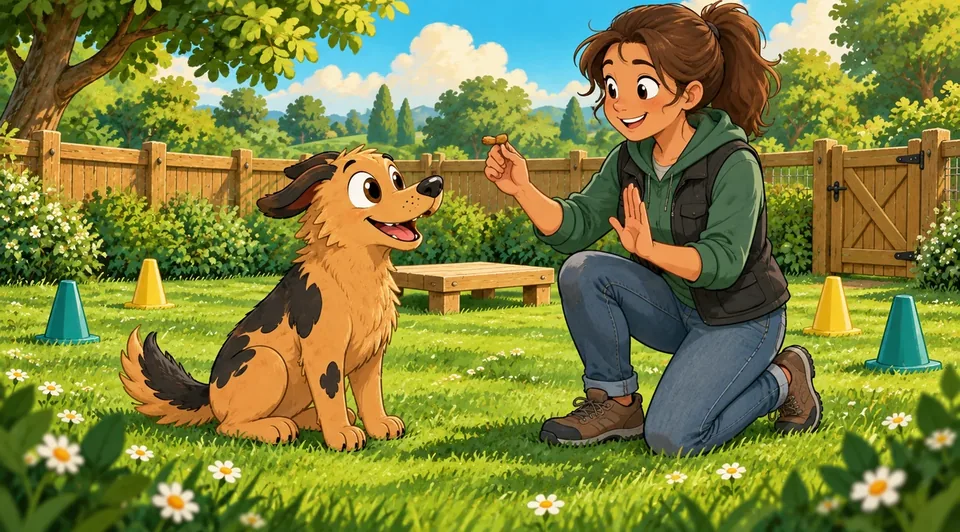
Classes are a popular way to fill the window, but the evidence is mixed: in the review, some studies found classes helped adult behaviour and others found no clear benefit1. Part of the reason may be how much classes differ6.
In Dogs Trust's Generation Pup study, 1,468 owners in the UK and the Republic of Ireland described the last puppy class they went to6. A third said all the puppies played together, and four in ten said they did not play together at all6. Asked what socialisation advice the class gave, 56.5% said as many new experiences as possible before 12 weeks, and 29.6% said to introduce new things gradually6. PDSA's vets ask for both: plenty of variety, built up gradually2.
Dog training is unregulated, with no set guidelines for classes6, so watch a session before you book if you can.
What to look for in a puppy class
Do
- A small group: the researchers flag classes of 11 or more dogs as a lot to keep positive for every puppy6
- Supervised play, with puppies taken apart when it gets too much for either2
- Floors that are easy to clean and disinfect, such as an indoor hall4
- Frequent rewards: treats, praise, petting and play4
- Checks that every puppy is up to date with vaccinations and free of parasites4
After 16 weeks, and when to get help
The window closing is not the end. AVSAB urges owners of puppies past three months to keep socialising them with as many people, pets and places as is practical4, and PDSA advises carrying on with new experiences, positively, throughout a dog's life2.
If your puppy often seems fearful, anxious or stressed, or growls or bares their teeth as a warning, see your vet first4, 8: there could be an underlying cause, such as pain8. Your vet can give you some first pointers and recommend an accredited behaviourist or trainer8.
Come 16 weeks, your puppy will not have met everything, and does not need to. What matters is that they have learned new things usually turn out fine, and that you are the one to check with when they are not sure.
Sources and further reading8 sources
The small numbers in the article link to the source behind each fact. Sources open on their own websites.
- Canine Socialisation: A Narrative Systematic Review
- Puppy socialisation
- Introducing your puppy to the world around them
- AVSAB Position Statement on Puppy Socialization
- Inadequate socialisation, inactivity, and urban living environment are associated with social fearfulness in pet dogs
- Factors Associated with Puppy Training Class Attendance
- Pandemic Puppies: Demographic Characteristics, Health and Early Life Experiences of Puppies Acquired during the 2020 Phase of the COVID-19…
- How to tell if your dog is happy