

In this article
It is a damp October morning and the path under the horse chestnuts is studded with conkers, glossy as boiled sweets. Your dog's nose goes down, there is a crunch, and you are left wondering whether that was a conker, an acorn or something worse.
Those few seconds matter. PDSA warns that conkers and acorns can cause tummy upsets or even a potentially life-threatening blockage if swallowed1. You cannot sweep the woods clean, but you can teach your dog to look away from what they find, and back up at you.
Here is a 'leave it' built in stages, from your hand to the woodland floor, plus a 'this way' cue for when you spot trouble first, a swap for when your dog gets there before you, and a clear line on when to ring the vet.
What autumn leaves on the path
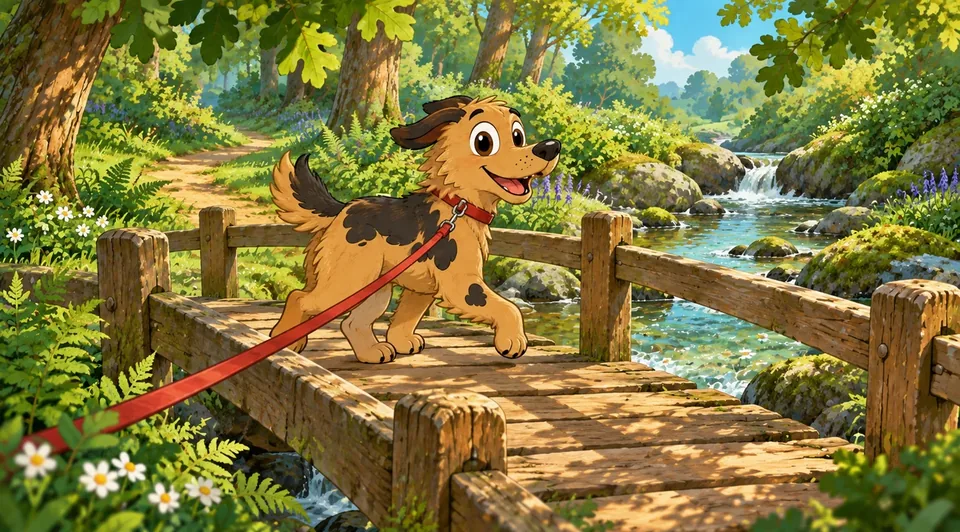
Conkers and acorns are the obvious ones. As well as possibly making a dog unwell, their size and shape means they can cause a dangerous blockage if swallowed2.
Windfall fruit comes next. Mould growing on rotting fruit can be toxic, and some pips and stones can cause sickness or a blockage2. Then there are fungi. Only some of the many species in the UK are toxic, but some of those can cause serious or even fatal problems1. Some are hard to tell apart, so the safest rule is that your dog eats no wild mushrooms at all2.
Teach 'leave it' at home first
Dogs Trust's method rewards your dog for looking away from something, with a treat from your other hand3. Start indoors, somewhere quiet, with a few tasty treats and an item your dog will find dull.
Teaching 'leave it', stage by stage
- Two hands, two itemsA tasty treat in one, a dull item such as dry food, a sponge or a piece of paper in the other3
- Offer the dull hand and waitLet your dog sniff, then wait for them to look or move away3
- Mark it and rewardThe moment they look away, mark it (a 'yes' or a click, if you use one) and give the treat from your other hand3
- Add the wordSay 'leave', hold out the item, and reward the look away as before3
- New places, then movementPractise somewhere new with distractions, then place the item on the floor and drop it from a low height3
- Raise the valueSlowly work up to things your dog finds more tempting3
If your dog struggles at any stage, go back to the last one they managed and progress more slowly3. Going back is part of the method, and it is how the habit gets strong enough to survive a wood full of smells.
Why the kitchen version may not hold in the woods
Here is the part that is easy to miss. Self-control in dogs does not seem to be one general skill that training turns up everywhere. Two studies suggest it is closely tied to the situation4, 5.
In a 2017 study, a team in Vienna put 67 dogs through five common self-control tests and found that how a dog did on one test did not line up with how it did on the others4. The researchers' reading is that self-control in dogs is highly context specific, not one general ability4.
A 2025 study in Kentucky tested 162 dogs on a widely used self-control test, comparing pet dogs that had little formal training with dogs that compete in agility, scent work and barn hunt. The trained dogs did no better than the untrained ones, and the barn hunt dogs did worse5. The authors suggest training self-control for each situation that needs it: waiting before dinner, before crossing a busy street, before greeting someone at the door5.
Neither study tested 'leave it' itself, but the likely lesson for it is plain. A dog who leaves a biscuit in the kitchen may only have learned to leave a biscuit in the kitchen. To leave a conker on a muddy path, they need practice where the conkers are.
Taking it onto the autumn path
Dogs Trust's method already moves to new places and adds distractions3, and an autumn path is the next new place. Go there in small steps, ideally before the conker carpet arrives, or straight away if it already has. Start on a quiet stretch with your dog on a lead, and use safe items first: drop a dull treat or a toy and ask for 'leave', just as you did at home.
Then walk past the real thing. While you are still training, keep your dog on a lead or a long line under horse chestnuts and oaks, so you are close enough to steer them past. Dogs Trust's advice is to keep an eye on what they sniff, pick up and eat2. Reward every glance away from a conker generously. Out here, it is a big ask.
Puppies and young dogs need extra care. PDSA's vets say young dogs tend to be more at risk of gut blockages, because they are very keen to explore the world with their mouths6.
What to take on an autumn walk
- High-value treats or a favourite toy, on every walk2
- A lead or long line for stretches under conker and oak trees
- A pocket or bag for anything you pick up before your dog does
- Your vet's number and their out-of-hours number, saved in your phone
When you see it first: 'this way'
'Leave it' is for the moment your dog has already found something. Better still is steering them past before they do. Dogs Trust suggests training a 'this way' cue in advance, and bringing high-value treats on every walk in case you need to tempt your dog away from something toxic2.
Build it on ordinary walks, when there is nothing to avoid. Say 'this way' in a bright voice, turn and walk off in a new direction, and reward your dog the moment they catch you up. Changing direction every so often also teaches a dog to keep a close eye on you7, which helps on every walk. Once the cue is easy, use it as soon as you spot a scatter of windfalls ahead.
When they get there first: the swap
Sometimes your dog will beat you to it. For those moments Dogs Trust advises a 'swap and drop': get your dog's attention, then throw a high-value treat or toy a short distance away, so they drop what they have in order to fetch the reward2. While they are busy with it, pick up the conker and pocket it.
The swap comes easier to a dog who already knows that giving things up pays. A 'fair trade' game at home builds that habit: instead of taking something from your dog, you trade it for something better3.
When to ring the vet, and when to call a trainer

If you see your dog eat a conker, an acorn, a wild mushroom or mouldy fruit, call your vet for advice straight away, and don't wait for symptoms to appear1. Never try to make your dog sick at home6. PDSA's vets also warn against waiting to see if a problem develops, because a dog with a blockage could become very ill, or even die, without treatment6.
Spotting trouble after the fact is harder than it sounds. In a 2026 UK study, 1,772 dog owners read short case histories based on real vet records, and in 28.4% of their answers they judged a problem less urgent than vets did8. The gut blockage case described a dog vomiting through the night after a long off-lead walk, with a history of scavenging, and it was among the conditions owners found hardest to name8.
If your dog still won't leave things however much you practise, some dog training lessons may help3. Choose a trainer who uses rewards. And if your dog guards what they pick up, stiffening or growling as you come near, ask your vet about a referral to a qualified behaviourist.
Put the practice in now and the conker carpet becomes just another stretch of path: a sniff, a glance back at you, and a happy trot on towards the treat in your pocket.
Sources and further reading8 sources
The small numbers in the article link to the source behind each fact. Sources open on their own websites.
- Which plants are poisonous to pets?
- Tips for keeping your dog safe this autumn
- How to train your dog to leave it
- Measures of Dogs' Inhibitory Control Abilities Do Not Correlate across Tasks
- Training Does Not Uniformly Increase Canine Self-Control
- Gut blockages in dogs
- Teach your dog to walk nicely on a lead
- To see or not to see the vet: A vignette-based study of decision-making by UK dog owners regarding seeking veterinary care…