

In this article
It is a wet Sunday, you have an hour to spare and a pocket full of treats, and your dog still regards "stay" as a polite suggestion. It is tempting to make a morning of it and keep going until it finally sticks.
The advice, and the little research there is, points the other way: a few minutes at a time, then a proper break. Here is how long a session should be, what research on sleep suggests happens after one, and a simple week of training you can borrow.
How long should a training session be?

The short answer from UK dog charities and the Royal Kennel Club is: not long. Dogs Trust suggests five to ten minutes at a time, working on one behaviour and then ending the session with a fun game1. The Royal Kennel Club asks owners who join a training class to commit to five-minute sessions several times a day5.
The RSPCA advises short but regular sessions so your dog isn't overwhelmed, always ending with something your dog knows so the session finishes on a positive note6. The Royal Kennel Club gives the reason for little and often: short daily spells keep a dog interested, and you progress faster5.
Nobody has pinned down a perfect number of minutes, as far as we could find. In a 2011 paper, researchers at the University of Copenhagen noted that how often and for how long a dog should be trained had not been fully investigated2. So they tested it, and research on sleep has since added something the advice tends to leave out: what happens between sessions matters too.
Why short, spaced sessions work better
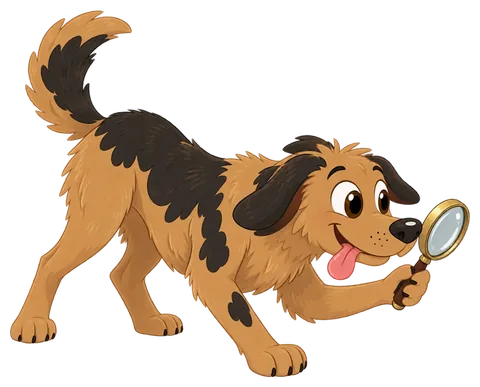
Their test used 44 laboratory beagles, each given 18 training sessions on a traditional obedience task. The four groups had different timetables: training once or twice a week or every day, and one session at a time or three sessions in a row2.
The dogs trained once or twice a week learned the task better than those trained daily, and one session at a time beat three in a row2. Weekly training with a single session gave the best results, while daily training with three sessions back to back gave the worst2. Every dog had the same 18 sessions, so the weekly groups took longer on the calendar to finish them2.
The memory held up, too. Tested four weeks after training, every group remembered the task well, and the researchers suggest that a learned task is likely to be remembered for at least four weeks after the last practice2.
It is one study of laboratory dogs learning one task, so it is no reason to train only once a week, and the Royal Kennel Club still recommends short spells every day5. Where the two agree is the part that matters most: keep each session short, and leave real gaps between them.
What happens while your dog sleeps on it
Take sleep first. In a 2017 study in Hungary, 15 pet dogs were taught English phrases for two things they already did on Hungarian commands: sit and lie down. Their brain activity was then recorded over three hours of sleep and compared with a recording after a session using the familiar commands3.
Learning changed the dogs' sleep. After the lesson, the pattern of their brain waves during sleep shifted, and features of that pattern were related to how much a dog improved3. On average, the dogs responded better to the new phrases after the three-hour recording than before it3.
A second analysis of the same dogs counted sleep spindles, brief bursts of brain activity in non-REM sleep that have been linked to memory consolidation in people and rodents4. The dogs had more of them after the learning session, and the dogs with more spindles improved more4.
This is small-scale work, and both analyses come from the same 15 dogs. The researchers say the amount of sleep that best helps memory is still to be worked out3. It is no proof that a nap makes a cleverer dog, but it does suggest that the rest after a lesson is part of the lesson.
What to do straight after a session
The same paper tested what dogs should do next. Another 53 pet dogs learned the new phrases and then spent an hour in one of four ways: a nap in their owner's parked car, a walk on the lead around a university campus, playing with a toy, or learning more new commands with their owner3.
When the dogs came back about a week later, the nap, walk and play groups were all doing better than at the start. The dogs who had gone straight on to another lesson had not improved3. The researchers' reading is that a second learning task gets in the way of the first while its memory is still settling3.
The researchers think the dogs' ordinary night's sleep at home did much of the work3, so there is no need to force a nap after every session. A game may even help in its own right: in a small study, 16 pet Labradors learned to choose the right one of two objects, then either spent half an hour walking and playing with a researcher or rested on a dog bed, gently kept from dozing off. The next day, the dogs who had played relearned the task in fewer tries7.
When 11 of those dogs were retrained a year later at the University of Lincoln, the play group still needed fewer tries, though the author points out how few dogs took part7. The resting dogs were kept awake, so the study does not set play against sleep, and the author suggests testing play followed by a longer sleep next7.
So once the lesson ends, let your dog snooze, potter about on a walk or have a game, and save the next new thing for later. It is the easiest part of training to get right, because all it asks of you is to stop.
Signs a session has gone on too long

Your dog will usually let you know when they have had enough, if you know what to watch for. Dogs Trust lists the signs, from subtle to more obvious, that a dog is worried or needs more space, and when you see them its advice is to give your dog that space, which can mean ending what you are doing together8.
Time to stop when your dog
- Stops enjoying it, or you do: Dogs Trust's tip is to pick it up another day1
- Turns their head or body away8
- Licks their lips when there is no food about8
- Yawns when they are not tired8
- Pulls their ears back8
- Goes suddenly still or freezes8
- Stops responding to words, treats or toys, which Dogs Trust counts as a more serious sign8
Struggling counts too. If your dog keeps getting it wrong, Dogs Trust's advice is to stop, go back a step and progress more slowly next time1. The same goes for you: the Royal Kennel Club's advice is that if you find yourself getting frustrated, stop, walk away and come back later with a clear frame of mind5.
A simple training week
The shape of one session
- Get readyRun through it once without your dog, then train somewhere calm after your dog has eaten and been to the toilet1
- Train for five to ten minutesOne behaviour, rewarded with praise or a tasty treat1
- Finish on a highEnd with something your dog already knows6, then a quick game1
- Then restA nap, a walk or some play, but not a new lesson3
Across a week, a pattern like the one below keeps every session short and leaves room for rest. Treat it as a template to bend around your own week. Days off are no setback: in the beagle study, the dogs trained once or twice a week learned more from their sessions than those trained every day2.
| Day | Training | Afterwards |
|---|---|---|
| Monday | Two five-minute sessions, hours apart, on one new behaviour | A nap or a chew |
| Tuesday | One session going over Monday's behaviour | A sniffy walk |
| Wednesday | Rest day | Ordinary walks and play |
| Thursday | Two short sessions, a little harder | A nap |
| Friday | One session in the garden | A game |
| Saturday | Five minutes somewhere quiet outdoors | Home for a snooze |
| Sunday | Rest day | Time together |
Dogs Trust suggests starting at home and moving outside once your dog has mastered the basics, which is why the garden comes later in the week1. It also suggests recording your progress, on film or in writing1. A few notes make it easier to spot when a behaviour is ready for the next step.
When to ask for help
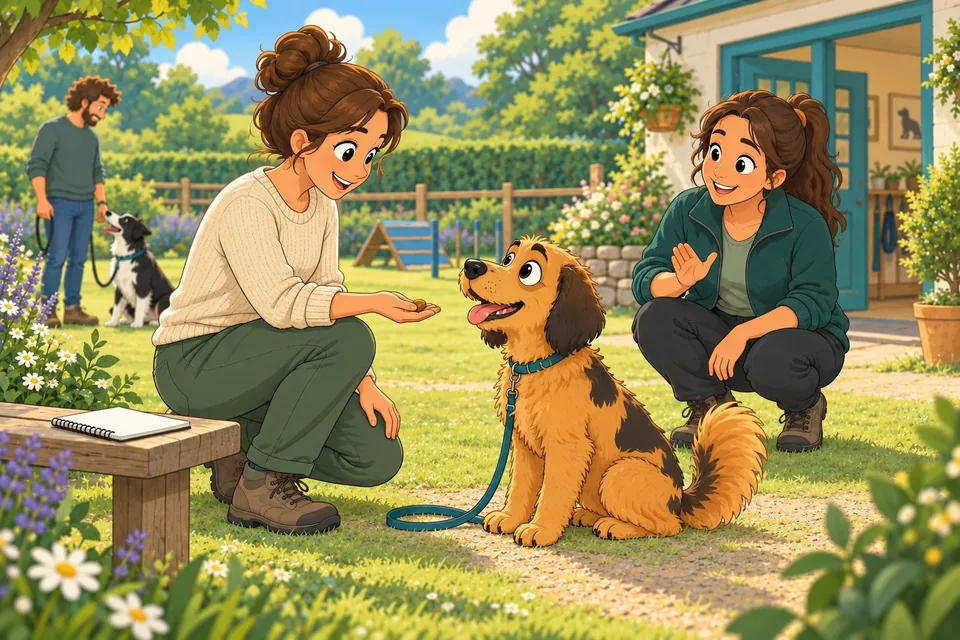
If progress stalls for weeks, or you are dealing with something bigger than a new trick, get help. The RSPCA suggests a dog training instructor if you need a bit of extra help, and a qualified behaviourist for problems such as excessive barking, aggression, destructiveness and phobias6.
And if a dog who usually enjoys training suddenly loses interest, seems sore or becomes snappy, see your vet first. Dogs Trust's advice is to speak with your vet if you are concerned about your dog's behaviour or notice any changes, so they can check whether a medical problem is behind it8.
So next wet Sunday, try five good minutes, a game, and then let your dog sleep on it. By the following weekend, "stay" may have come along further than you think.
Sources and further reading8 sources
The small numbers in the article link to the source behind each fact. Sources open on their own websites.
- Top 10 dog training tips
- The effect of frequency and duration of training sessions on acquisition and long-term memory in dogs
- The interrelated effect of sleep and learning in dogs (Canis familiaris); an EEG and behavioural study
- EEG Transients in the Sigma Range During non-REM Sleep Predict Learning in Dogs
- Introduction to dog training
- Dog training
- Dog–Human Play, but Not Resting Post-Learning Improve Re-Training Performance up to One Year after Initial Task Acquisition in Labrador…
- Why dogs get scared or frustrated and how to help them