

In this article
The towel comes off. Your dog looks at you, folds into a shape that barely seems aerodynamic, then completes three extremely important laps of the sitting room. The bath is over. Apparently, the sporting event has just begun.
Sudden, exuberant laps are commonly called zoomies, or “frenetic random activity periods” (FRAPs). Cornell notes they occur in young dogs and some adults1.
A familiar sight with an unfinished explanation

Cornell describes bursts that can appear during play, later in the evening, after an exciting event or when a dog becomes overstimulated during training. These observations help identify the pattern people mean when they say “zoomies”; they do not establish a single cause1.
In an expert article, University of Adelaide authors Susan Hazel, Ana Goncalves Costa and Julia Henning describe a shortage of research into causes, frequency and even an agreed definition. Their explanation is informed commentary, rather than the result of a trial that tested why dogs dash about2.
That distinction leaves plenty of room for enjoyment. You can recognise your own dog's familiar little circuit without pretending the name explains everything happening inside them. FRAPs is a memorable collection of letters; it is not a laboratory result.
Why after a bath, or late in the evening?

The Adelaide authors describe post-bath, park and night-time episodes among familiar examples. They suggest excitement or increased stimulation as possible triggers. They also say research has not settled whether episodes occur more at particular times or in particular breeds2.
So “it often happens after our bath” can be a useful observation about your dog. It does not demonstrate a universal post-bath mechanism. The same article treats unusually prolonged, difficult-to-interrupt or injurious episodes as a reason to seek veterinary help2.
For your own household, start with a description you could show someone else: “After drying, she ran between the rug and the door, then stopped.” That is more useful than a confident story about which hormone must have surged. The observation can stay accurate while the explanation remains open.
Dogs Trust describes puppy zoomies as normal, while noting that boredom, frustration, worry and being overtired may make puppies more hyper. An energetic-looking puppy is therefore not automatically asking you to add another exhausting activity3.
Excitement still needs a little context
Dogs Trust's body-language guidance describes loose, bouncy movement during excitement and play. It also notes that zoomies during dog-to-dog play can accompany overstimulation. Both the situation and the rest of the body matter when deciding whether to call a break4.
If a playmate is involved, watch that dog too. Repeated pinning, hardening mouth play, difficulty responding to instructions and intense one-sided chasing are among Dogs Trust's reasons to interrupt. One dog's burst of enthusiasm does not oblige the other to join in4.
The charity recommends calling your dog away when you are unsure everyone is enjoying the game. If another dog moves away or shows anxiety, giving them that break was useful. Respect the pause instead of sending the dogs straight back together4.
A review of dog play offers a broader caution: play is not a reliable, general-purpose indicator of positive welfare. Its functions and meaning depend on the animal's history and the context. The authors discuss play as a varied behaviour, rather than one uniform measure of how well life is going5.
Applied here, that means the label “playful” should leave room for the rest of your dog's day. An amusing burst of movement cannot by itself answer every question about comfort, opportunities, relationships and rest. This is an interpretation of the review's broader warning, rather than a zoomies experiment5.
Prepare a place for the fast bit
Cornell advises avoiding stairs, slippery floors, obstacles and roads. Check the route out of the drying area before opening the door1.
A quick space check
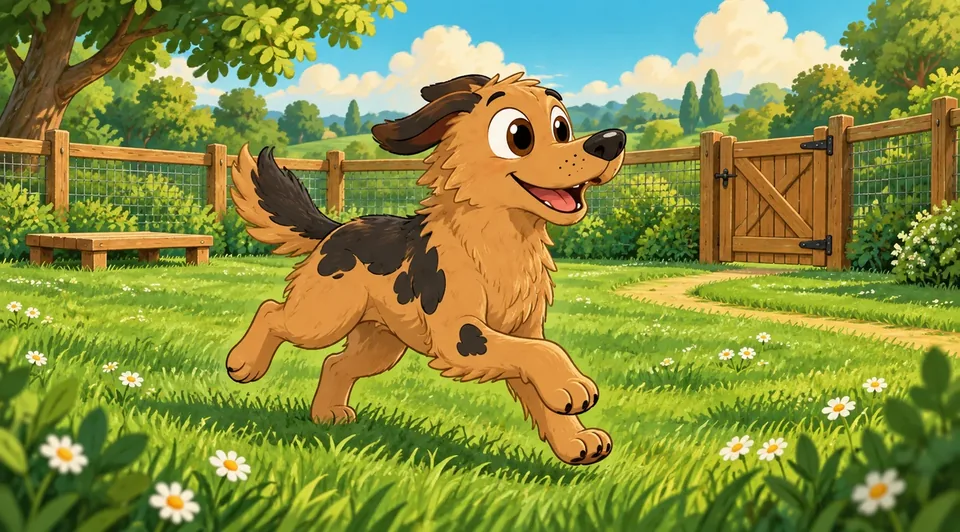
Outdoors, PDSA recommends a lead near roads and livestock, and reward-based recall practice in enclosed places before off-lead freedom in open space. A sudden burst is much easier to accommodate when the surroundings already suit running6.
PDSA also advises introducing exercise gradually and tailoring it to age, health, fitness and preferences. If a dog is recovering from illness or injury, follow the vet's activity instructions. A dog who appears keen to race still needs those individual limits respected6.
Hot weather needs an adjustment too: PDSA recommends cooler times of day for exercise and taking water. Its play guidance cautions about repeated quick starts and stops in fetch, especially for dogs with joint risks or on slippery ground. Adding a ball to every burst is therefore no automatic improvement6.
These are general exercise precautions, not evidence that one layout or routine prevents zoomies. The practical aim is to give your dog an appropriate environment for the activity you can see.
Give the quieter parts of the day a place
Dogs Trust recommends a predictable routine with suitable exercise, enrichment and opportunities to rest. After excitement, activities such as sniffing, chewing or licking may help a dog settle. Puppies need chances to nap during the day as well as sleep overnight3.

Give them a comfortable, peaceful resting area and avoid treating every lively moment as proof that they need more running. Dogs Trust notes that too much exercise and being overtired can also make settling difficult3.
RSPCA guidance recommends regular opportunities to walk, run and play, safe toys, and a safe place to retreat from things a dog finds frightening. Its training advice uses rewards and rejects shouting or punishment. That gives you a useful framework for the ordinary day surrounding the occasional dash7.
For example, review whether your dog has appropriate opportunities for activity and somewhere to withdraw when the household is busy. This is an application of general welfare guidance. It does not imply that a dog with zoomies has been under-exercised, or promise that a better routine will remove every episode7.
The aim is a day you and your dog can live comfortably, including the unremarkable stretches between the entertaining ones. A quiet afternoon does not need to be filled with a sporting fixture.
When the pattern deserves a closer look
The MSD Veterinary Manual distinguishes ordinary unwanted behaviour from abnormal repetitive patterns, which can include spinning and other fixed movements. Intense repetitive behaviours may be difficult to interrupt. A vet needs to consider the history and rule out health problems before making a behavioural diagnosis8.
If the pattern concerns you, describe when it started, how often it happens, how long episodes last and what happens before and afterwards. A safely recorded video can help the vet understand what you mean. Record what occurs naturally; you need not produce another episode to make your account useful8.
The diagnosis does not come from the nickname. Saying “zoomies” should not close the conversation if the behaviour has changed or is interfering with ordinary life. Conversely, a lively lap around the garden is not enough by itself to diagnose a repetitive behaviour disorder8.
For a familiar, comfortable burst in a suitable space, put the towel down and enjoy the view1.
Sources and further reading8 sources
The small numbers in the article link to the source behind each fact. Sources open on their own websites.
- What are zoomies?
- Why do cats and dogs get the zoomies?
- Helping a hyper or restless dog to calm down
- How to understand your dog's body language
- Why do dogs play? Function and welfare implications of play in the domestic dog
- Exercising your dog
- Understanding your dog's behaviour
- Diagnosing Behavior Problems in Dogs