

In this article
You sit down with a slice of toast and there it is: your dog at your knee, head tipped back, the inner corners of the eyebrows lifted so the eyes look rounder and a little forlorn. Researchers who code dog faces call this movement AU101, the inner brow raiser1.
In 2019 a team of psychologists and anatomists reported that dogs have a small muscle for the look that wolves mostly lack, and suggested that people had favoured it as wolves became dogs2. The story has taken a turn since. Wild coyotes turn out to have the muscle too3, and an experiment with pet Labradors linked the movement to the way a dog moves its eyes4. Here is what each study found, what is still a hypothesis, and what it means at your table.
The movement behind the look
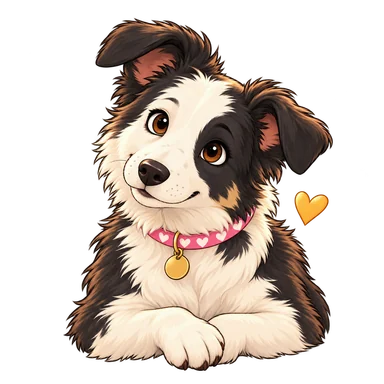
Try lifting the inner ends of your own eyebrows. Your forehead creases and your eyes seem to open wider. A dog's inner brow raise works in a similar way, making the eyes look bigger, a feature we associate with babies1. In people, the matching movement is a big part of looking sad1.
The muscle that does the lifting has a mouthful of a name, the levator anguli oculi medialis, so we will call it the inner-brow muscle2. A second small muscle pulls the outer corners of the eyelids back towards the ears2. Because the brow raise makes a face look younger and sadder, the 2019 researchers proposed that it may trigger a nurturing response in people2.
What the dog and wolf dissections found
The 2019 team dissected the heads of six dogs (a Labrador, a bloodhound, a Chihuahua, a German shepherd, a Siberian husky and a mongrel) and four wild wolves from Alaska and Michigan2. Most facial muscles matched; the differences were around the eyes2.
Six dogs, four wolves
In the wolves, the researchers typically found only scant muscle fibres in a mass of connective tissue, sometimes with a small tendon where the inner-brow muscle would be expected2.
The authors concluded that domestication had transformed the muscles of the dog's face for communicating with people, a remarkably fast change in their words2. That conclusion rested on four wolves, a point later researchers would return to3.
Dogs raise their brows more than wolves
Anatomy shows what a face can do. To see what dogs and wolves really do, the team filmed 27 dogs in UK rescue shelters, mostly Staffordshire bull terriers, and nine wolves at two animal parks in the UK and Germany, each for about two minutes while a stranger stood facing them2.
In those two minutes the typical dog raised its inner brows 10 times, the typical wolf twice2. At the faintest intensity the two species looked alike, but stronger raises were more common in dogs, and the two strongest grades were seen only in dogs2.
Shelter dogs and park wolves lead very different lives4. A 2025 study took on that problem by comparing animals raised the same way. At a research centre in Austria, where wolves and dogs are hand-raised and live in packs with daily human contact, the 11 dogs held their inner brows raised for longer than the 11 wolves while greeting people they knew through a fence5.
Only two of the 12 facial movements measured differed between the species5. The ears told the bigger story: the wolves mostly kept theirs pointed forwards, while the dogs more often rotated or lowered theirs, positions the authors link with ambivalence or submission5.
The people differed too, with more expressive and more positive faces towards the dogs5. The authors say that makes it hard to tell whether the animals' differences come from domestication or from how people treat them5.
A brow raise and a new home
Evidence that people may favour the look comes from a 2013 study at four UK rehoming centres, including Dogs Trust West London at Harefield, RSPCA Southridge and Wood Green1. The researchers analysed 27 bull-breed dogs, each filmed for two minutes as a stranger stood at the front of its kennel, and counted the days until each was rehomed1.
Dogs that raised their inner brows more often were rehomed faster1. The researchers' fitted curve predicted that a dog making five brow raises in the two minutes would wait about 50 days for a home, and one making 15 about 28 days1. Tail wagging did not help: dogs that wagged for longer waited longer1.
Hold that lightly. None of the links would survive a standard correction for making many comparisons, the authors noted, and they called the findings exploratory1. The study was funded by a WALTHAM Foundation grant, and one author worked for the WALTHAM Centre for Pet Nutrition, part of Mars; the funder had some input into the design but, the authors state, none into the findings1. The authors also pointed out that these expressions may not reflect how well a dog would suit you as a pet1.
Is the look meant for us?

If puppy dog eyes are a message, dogs should make them when someone is watching. In a 2017 study of 24 family dogs in Germany, the dogs raised their inner brows about twice as often when a person faced them as when she turned her back; showing them food made no difference7. The authors suggested the expressions may be partly communicative, but could not rule out a hardwired or learnt reaction to seeing a face7.
A 2021 study turned this on its head. Researchers in Switzerland trained 21 family Labradors (one of them a cross) to wait for a reward handed over by a person facing them or dropped by a machine4. Facing the machine, the dogs moved their eyes more and raised their brows more often4. The brow raise travelled with eye movements, happening without one in only 6% of cases4.
Their suggestion is that earlier results may partly reflect where the dogs were looking: to meet the eyes of a standing person, a dog has to look up, and its brows tend to move with its eyes4. The team calls this explanation speculative, though consistent with the data then available4.
The twist: coyotes have the muscle too

If domestication built the inner-brow muscle, the dog's wild relatives should lack it. In 2024, researchers in Texas dissected 10 coyotes and found a distinct, well-developed inner-brow muscle, much like a dog's, in every one3. Coyotes branched off before wolves and dogs parted, so the authors argue the muscle is probably an old trait that grey wolves lost or reduced3. That challenges the domestication idea, they say, though they cannot rule it out completely3.
They add that two of the 2019 wolves came from Michigan, where wolves have interbred with related species, and call for comparisons of wolves of known ancestry3. In 2026, dissections of 12 animals from four South American wild canid species, including the maned wolf, found both eye muscles in every one6. Those authors conclude the muscles probably predate domestication, though they looked at only two to four animals of each species and did not measure the muscles6.
So the real puzzle may be how grey wolves came to lose the inner-brow muscle3, 6. The behaviour still stands, though: dogs raise their brows more than wolves do2, 5.
| Idea | What the research shows |
|---|---|
| Wolves mostly lack the inner-brow muscle | Based on four wolves; researchers want wolves of known ancestry checked2, 3 |
| Dogs raise their brows more than wolves | Seen in two studies with very different set-ups2, 5 |
| The muscle appeared through domestication | Challenged: coyotes and four South American canids have it3, 6 |
| The look is a message to people | Debated: it also travels with eye movements4, 7 |
| Brow raisers find homes faster | One small, exploratory shelter study1 |
What to do when your dog gives you the look

None of this makes the look any less lovely, but it does suggest reading it with care. A raised brow usually comes with a movement of the eyes4, and in the 2025 greeting study much of the difference between dogs and wolves was in the ears5. Treat the brows as one clue among several, along with what has just happened.
Puppy dog eyes at home
Do
A sore eye is a different matter from a raised brow. The PDSA lists weeping, redness or swelling, cloudiness and a showing third eyelid among the signs of eye problems, and advises contacting your vet as soon as you notice a change, as untreated problems can lead to loss of sight8.
So the next time those brows lift over the toast, you are looking at a muscle scientists are still arguing about, in a face that has spent a long time watching ours. Whether it is really asking for toast is between the two of you.
Sources and further reading8 sources
The small numbers in the article link to the source behind each fact. Sources open on their own websites.
- Paedomorphic Facial Expressions Give Dogs a Selective Advantage
- Evolution of facial muscle anatomy in dogs
- Coyotes can do ‘puppy dog eyes’ too: comparing interspecific variation in Canis facial expression muscles
- ‘Puppy Dog Eyes’ Are Associated With Eye Movements, Not Communication
- Differences in dogs’ and wolves’ human-directed greeting behaviour: facial expressions, body language, and the problem of human biases
- Beyond Domestication: Occurrence of Levator Anguli Oculi Medialis and Retractor Anguli Oculi Lateralis in Four Neotropical Canid Species
- Human attention affects facial expressions in domestic dogs
- Eye problems in dogs - an overview