

In this article
You pull on a werewolf mask, walk into the kitchen and wait for the usual wag. Instead your dog stops dead, backs away and barks at you as if a stranger had let themselves in. You are the same person you were a minute ago. To your dog, you may not look it.
Research on how dogs recognise people helps explain why. In lab tests, most dogs leaned on the outline of a person's head and on their hair1, 2, and only a few managed with the face alone1. Plenty of costumes change some or all of that. Here is what the experiments found, and how to help your dog see past a costume before the doorbell starts ringing.
The experiment with the digital balaclava
The neatest test comes from the Clever Dog Lab in Vienna. Researchers trained 15 pet dogs to tell two familiar women apart, the dog's owner and a friend of the owner the dog saw regularly, by touching the right one's face with their nose for a treat1. The women sat or knelt inside a box and pushed their heads through two holes in its front, looking straight ahead with neutral faces1.
Then the task got harder: life-size photos of the same heads, and then the same photos with a digital balaclava laid over them, hiding the hair and the outline of the head so that only the eyebrows, eyes, nose, cheeks and mouth showed1.
How the 15 dogs got on
Photos threw the dogs at first, but most relearned the task1. The balaclava was another matter. The researchers think it very likely that all but two dogs had been using outer features such as hairstyle, and could not switch to the face itself when that was all they had1.
The two successes show that dogs can in principle tell people apart by the face alone1. It was a small study, with women only and the same two faces throughout.
Why the outline of your head matters
A team at the University of Padua then asked a plainer question. Given their owner's head and a stranger's, poking through openings on opposite sides of the room, which would a dog walk up to2? With a clear view, dogs went to their owners more often than chance. With a poorer view (the head at an angle, uneven lighting and the outline hidden), they did not2.
A second experiment pulled those changes apart. Seeing the outline of the head was what let dogs find their owner; a face turned to the front, or evenly lit, was not enough on its own2. The authors called it the first clear demonstration that dogs recognise human faces, with the outer parts of the face key to it2.

Still, the inner face counts, and the eyes may count most. In a small 2014 study at the Vienna lab, seven dogs learned on a touchscreen to pick their owner's photo over a stranger's7. Covering the owner's eyes with a picture of sunglasses made the task slower to learn than with the whole face; a clown nose, or a scarf over the mouth, made no difference the study could detect7.
Put the studies side by side and the Halloween puzzle makes sense. A mask hides the inner face, including the eyes that seemed to matter most on the touchscreen7. A wig, a hood, a witch's hat or a full rubber head changes the outline and the hair that most of these dogs seemed to rely on1, 2. Nobody has tested this on a doorstep on 31 October, so treat it as a reasonable reading of the lab work.
What brain scans add
In people, brain imaging points to dedicated face regions3. Earlier, smaller scanner studies in dogs had found areas that responded more to faces than to objects, but their designs could not separate a response to faces from one to living things or bodies in general3.
So a team working in Budapest and Mexico tried a stricter test, published in 2020. Twenty family dogs and 30 people watched the same short videos of unfamiliar human and dog faces, and of the backs of human and dog heads3. In the people, key face regions responded more to faces than to the backs of heads. In the dogs, no region did. What the dog brains picked out was species: an area on each side responded more to dogs than to people3.
The team say that finding nothing is not conclusive evidence against face areas in dogs, and they point out that dogs are drawn to faces all the same3. Dogs look at us. Their brains just do not seem to organise what they see around faces the way ours do3.
Your voice still helps
If your outline is unreliable on Halloween, your dog has other clues. In a study at Kyoto University, dogs heard a recorded voice, their owner's or a stranger's, and then saw a photo of one of the two on a screen4. They looked at the photo for longer when the face and the voice did not match4.
The researchers suggest that dogs call up a picture of their owner's face when they hear the owner calling them4. That makes your voice worth using when the rest of you looks strange.

The Vienna team suggest that in everyday life, scent and voice may be more distinctive or easier for a dog to judge, and that if sight is involved, movement is a strong candidate1. One Halloween catch: Battersea notes that some masks muffle or change the sound of your voice, which can confuse a dog5.
Getting your dog used to your costume
Battersea's advice on face masks was written for the pandemic5, but its steps suit a Halloween mask too. Start at home or somewhere familiar where your dog can relax, and build up over a few sessions if you need to5.
Five steps, a few days before
- Hold it, don't wear itStand beside your dog with the mask in your hand and ask for something they know, such as a sit, until they respond as usual5
- Not ready? Play firstPut the mask on the floor a little way off, play together, then put it away and try again the next day5
- Up to your face, brieflyHold it to your face for a second or two and reward straight away5
- Put it onBuild up over a few sessions until your dog stays calm and responds to you as normal5
- Then someone they live withThey come into the room in their mask without approaching, and you reward your dog for staying calm5
If your dog looks worried, go back a step, or cover your face a little at a time5. Talk to them throughout in your usual voice, the clue the Kyoto study suggests they tie to your face4. We would treat a wig, a hood or a hat the same way.
Keeping Halloween night calm
Dogs Trust notes that dogs may find unexpected knocks at the door and people dressed in costumes unsettling6, so most of the advice for the night keeps both away from your dog.
On Halloween night
Do
Don’t
- Take your dog trick-or-treating without thinking twice: even dogs who take costumes in their stride may not enjoy it for as long as you do6
- Put your dog in a costume. Dogs Trust says to keep dressing up for humans, as an unfamiliar thing to wear can make a dog uncomfortable6
- Leave sweets within reach. Many human treats, especially chocolate, are toxic to dogs6
Signs your dog is worried, and when to get help
Barking at a masked figure is hard to miss. The quieter signs of a worried dog are easier to overlook, and the PDSA lists these among them8:
Quieter signs to watch for
- A low or tucked tail, or low, slow wags
- Ears pinned back flat against the head
- A tense body, a lowered head, or looking away to avoid eye contact
- Turning their head away from you
- Licking their lips or yawning
- Going very still, or hiding and walking away
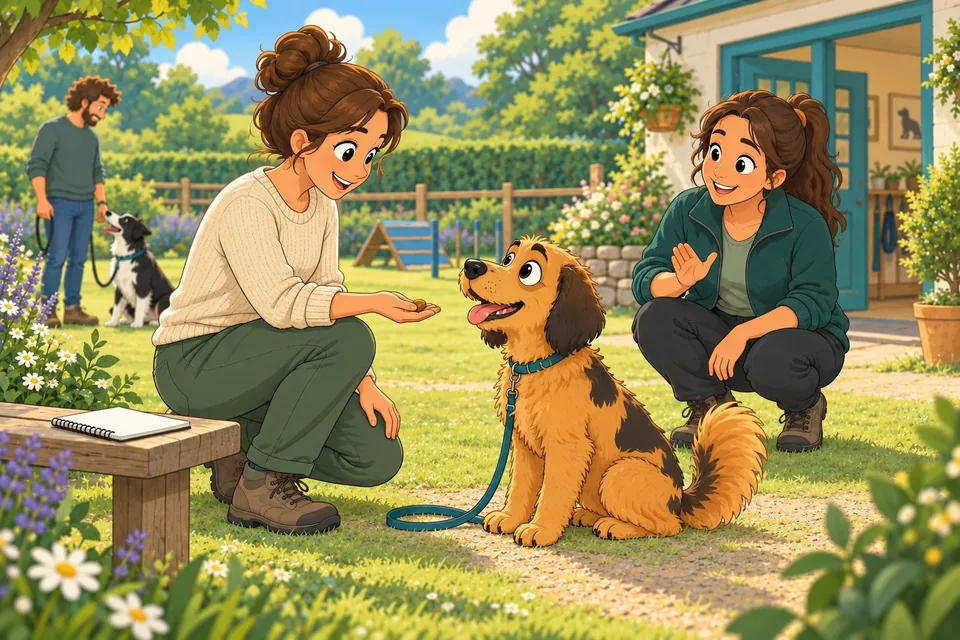
If you see these, take the costume off and give your dog some space. If they hide or walk away, let them, and do not follow8. If your dog shows signs of anxiety or stress on a regular basis, see your vet first, as there could be an underlying cause, and ask them to recommend an accredited behaviourist or trainer8.
Under the werewolf you are still the person who fills the food bowl. Give your dog a few calm sessions to put the two together, and the mask can stay a party trick while they snooze somewhere quiet.
Sources and further reading8 sources
The small numbers in the article link to the source behind each fact. Sources open on their own websites.
- Discrimination of familiar human faces in dogs (Canis familiaris)
- Recognition of human faces by dogs (Canis familiaris) requires visibility of head contour
- Comparative Brain Imaging Reveals Analogous and Divergent Patterns of Species and Face Sensitivity in Humans and Dogs
- Dogs recall their owner's face upon hearing the owner's voice
- Getting dogs used to people in face masks
- Halloween advice
- Part-Based and Configural Processing of Owner's Face in Dogs
- How to tell if your dog is happy