

In this article
Your dog is ten, grey around the muzzle and fond of the sofa, and you have just watched a younger dog in the park weave neatly between its owner's legs. Could yours still learn something like that? The old saying is gloomy about it. The research is far more encouraging, with a few footnotes worth knowing.
Scientists have tested how dogs' thinking changes with age in several ways, from touchscreen puzzles in a Vienna lab1 to owner surveys covering more than 15,000 dogs in the United States2. Here is what slows down, what holds up, what goes with a sharper mind, and when a change is a reason to see your vet.
How learning changes as a dog ages

One detailed picture comes from the Clever Dog Lab in Vienna, where researchers taught 95 Border Collies, aged from five months to almost 14 years, to choose between pictures on a touchscreen by touching the right one with their nose1. Testing a single breed meant that different breeds ageing at different speeds could not muddy the results1.
The number of sessions a dog needed to learn each task rose steadily with age1. The youngest dogs, under a year old, learned fastest, and the researchers say learning ability began to decline from that age onwards1. Older dogs also needed more correction trials, repeating a wrong choice instead of adjusting to feedback, which the team read as reduced flexibility1.
Memory told a happier story. After a break of at least six months, 46 of the dogs came back to repeat a picture task. Forty-two of them scored above chance in their very first session, and age made no difference1. The researchers add that six months was probably too short a gap to show any effect of age, so treat this as encouraging but not settled1.
In numbers
- 95Border Collies, aged five months to almost 14 years, took the touchscreen tests1
- 42 of 46returning dogs scored above chance on a task they had learned at least six months earlier1
- Over 80%correct first choices on day one when the team later retested five dogs of other breeds, three to five years after training1
What happens to attention

Paying attention is where training starts, so a team at the same lab tested it in 185 pet dogs aged six and over: 75 Border Collies and 110 dogs of other breeds and mixes4. In one part of the test, each dog watched a toy watering can bob up and down on a fishing line. In the other, a researcher walked in and pretended to paint an invisible wall4.
Older dogs were slower to turn and look, and dogs aged ten and over held their gaze for the shortest time4. One kind of attention did not decline: in a task where dogs switched between finding a dropped treat and looking up at the researcher's face, the speed of that eye contact did not change with age4. Older dogs did take longer to find the food itself, which the authors say could come down to failing sight, hearing or smell4.
Dogs with more training behind them, from puppy classes to agility, watched for longer and made eye contact faster, and the authors concluded that lifelong training seemed to delay or reduce the ageing of attention4. Training was scored from owners' questionnaires, so this is a link that cannot show the training caused it. Within the five-minute eye-contact task, though, the dogs as a group got quicker as they went: learning on the spot, at every age tested4.
Do older dogs stay trainable?
A third Vienna study recruited 119 pet dogs from 30 breeds and mixes, aged six to 14, and tested them on 11 tasks at the start and again a year later; 94 were analysed3. Every dog had a vet check first: dogs with signs of arthritis or other painful conditions, or marked loss of sight or hearing, were left out, and none scored as having cognitive dysfunction3. Problem solving, playfulness and boldness declined with age, and so did how closely the dogs stuck to their owners. Trainability, which combined attentiveness and learning success, did not3.
Most interestingly, we found no change in Trainability with age.3
The same study found no effect of lifelong training on any measure, though the authors note that their dogs' training scores were low and varied little3. So the evidence on training earlier in life is mixed. The authors also point to studies showing that owners play and train less with dogs over seven, and they urge owners to invite older dogs to play, within their physical capabilities3.
Activity, enrichment and a sharper mind
The biggest numbers come from the Dog Aging Project in the United States. Owners of 15,019 dogs filled in a 13-question survey about behaviours such as pacing, getting stuck behind objects and failing to recognise familiar people2. In all, 1.4% of the dogs scored high enough to be classed as having canine cognitive dysfunction2, the condition the PDSA calls dog dementia6. That figure covers dogs of all ages, whose average age was about seven2.
Even after allowing for health, breed type and other factors, the odds of a high score rose by 52% with each extra year of age2. Dogs described as not active had 6.47 times the odds of very active dogs of the same age and health2. The researchers say plainly that the link could run the other way, with dogs slowing down because their minds are declining, and that something unmeasured, such as how much owners interact with their dogs, could add to it2.
Firmer evidence of cause comes from the lab, from dogs whose lives differ a lot from a pet's. In a two-year study of older beagles, a programme of behavioural enrichment improved how well they learned to tell objects apart7. A later review describes that enrichment as more exercise, time with other dogs and thinking tasks8. The Vienna authors draw a similar conclusion from the wider research: continued enrichment through training, exercise, play and new toys can help to maintain cognitive function3.
Teaching an older dog something new
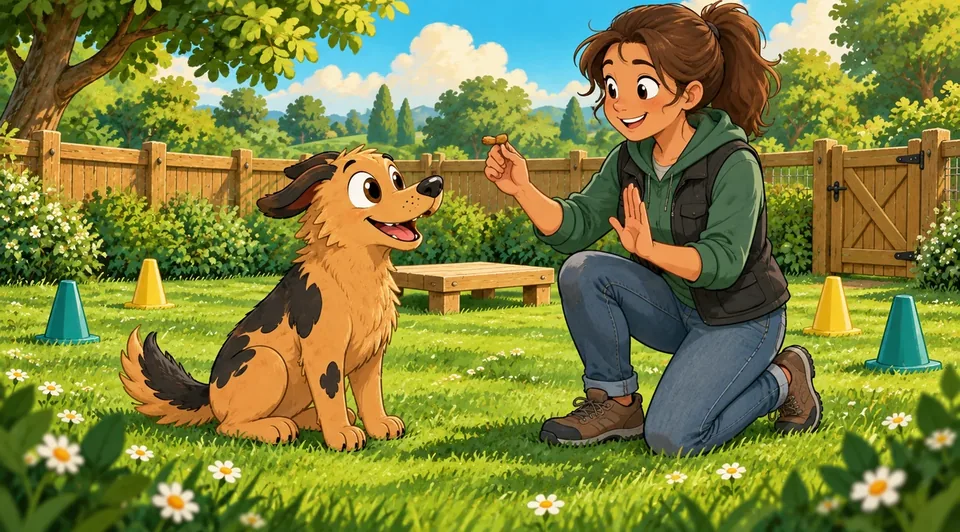
Both the PDSA and Dogs Trust say that old dogs can still learn new tricks, and the PDSA calls training a great way to keep an older mind active6, 5. Dogs Trust adds one condition: it should not be too physically strenuous5. Beyond that, a few changes can help, matched to what the studies found.
| What may change | What helps |
|---|---|
| New tasks take more sessions1 | Short sessions, small steps, and patience with wrong answers |
| Attention drifts sooner4 | A quiet spot, and stopping while they are still keen |
| Hearing fades | New ways to communicate, such as hand signals; some dogs still hear a whistle but not your voice5 |
| Stiff joints | Low, gentle games, without jumping or twisting for toys6 |
| Slippery floors | A rug or mat underfoot for grip6 |
| Nose still keen | Scent games, which suit any age while the sense of smell is good6 |
Pick rewards your dog loves, keep the mood light, and treat a muddle as a sign to make the next step easier. If your dog has trouble getting around or loses interest in exercise, the PDSA suggests a trip to the vet, as there may be aches and pains that can be eased6.
When a change is more than ageing

The changes in these studies turned up in dogs judged to be healthy3, 4, so some slowing is part of growing old. Other changes are different. Dogs Trust says to tell your vet at the first sign of a change in behaviour, and recommends check-ups twice a year for an ageing dog5.
Senses matter too. In the US survey, dogs with a history of eye or ear disorders had higher odds of a high score, and the researchers point out that a dog who walks into doors or cannot find dropped food may be losing their sight or hearing, which can push the score up as well2. A vet can help tell these apart, and can check for pain at the same visit.
Changes worth mentioning to your vet
So go ahead and teach the ten-year-old something new. It may take more sessions and more treats than it would have at two, but the studies suggest the learning is still there, and a few minutes together on the rug is a reward for both of you.
Sources and further reading8 sources
The small numbers in the article link to the source behind each fact. Sources open on their own websites.
- Aging effects on discrimination learning, logical reasoning and memory in pet dogs
- Evaluation of cognitive function in the Dog Aging Project: associations with baseline canine characteristics
- Behavioural and cognitive changes in aged pet dogs: No effects of an enriched diet and lifelong training
- Aging of Attentiveness in Border Collies and Other Pet Dog Breeds: The Protective Benefits of Lifelong Training
- Caring for an older dog
- Exercising your senior dog
- Learning ability in aged beagle dogs is preserved by behavioral enrichment and dietary fortification: a two-year longitudinal study
- Prevention approaches in a preclinical canine model of Alzheimer’s disease: benefits and challenges